
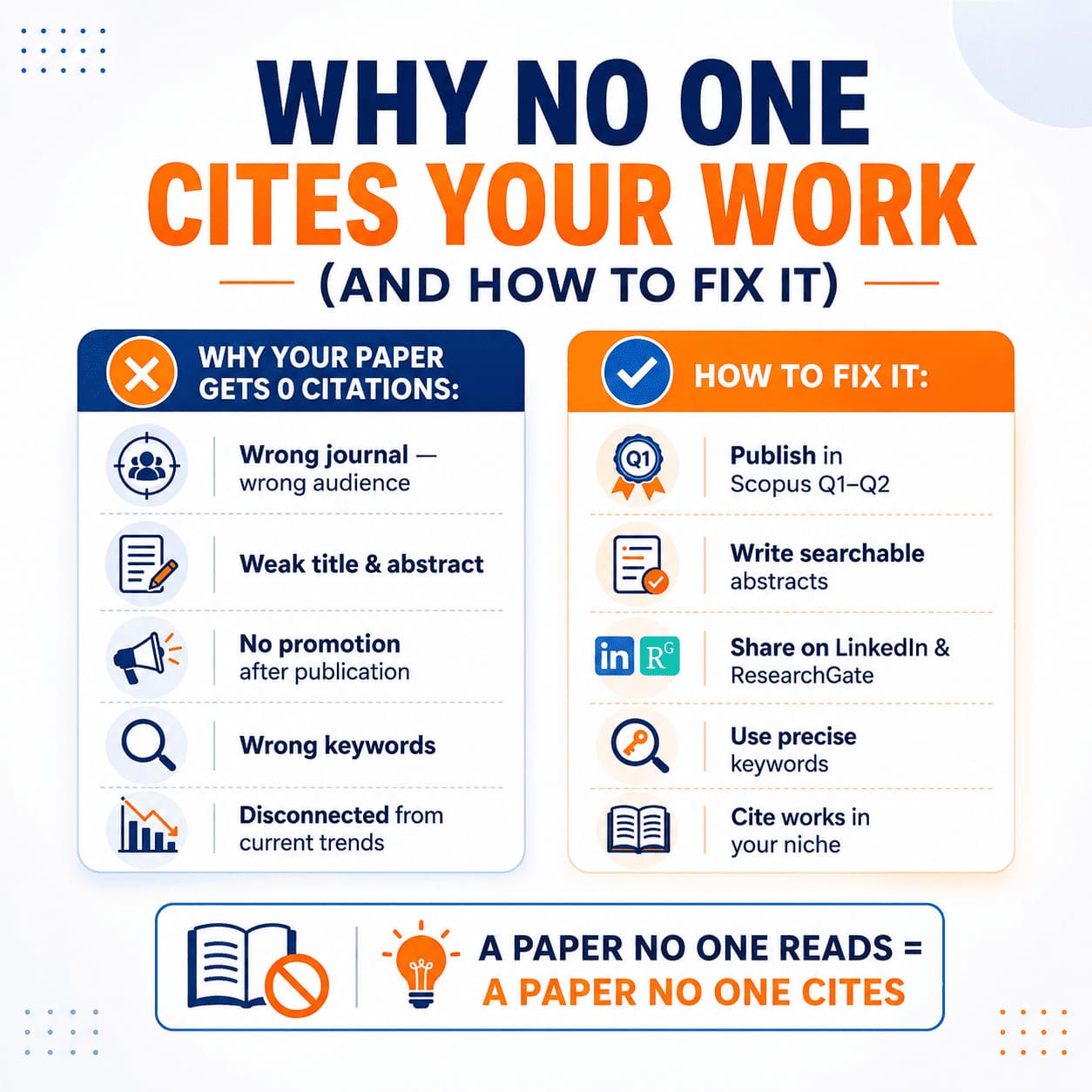
The Citation Gap Nobody Talks About
You worked for months, got peer-reviewed, and then got published.
Then — silence.
No citations. No engagement. Just a DOI sitting in a database no one visits.
This is the hidden crisis in academic publishing. Getting published is hard. But getting cited is a completely different battle — and most researchers don’t know they’re even fighting it.
According to research published in PLOS ONE by Larivière et al. (2009), over 82% of humanities papers and 72% of social science papers receive zero citations within five years. Even in high-impact fields like medicine, nearly 45% of papers go uncited.
The problem isn’t your research. It’s your visibility strategy.
Why Your Paper Gets 0 Citations
1. You Published in the Wrong Journal
Even excellent research fails when it reaches the wrong audience. A marketing study buried in a general business journal never reaches marketing scholars. Journals carry specific communities. You need to publish where your peers actually read.
- Target journals where your references already appear
- Use Scimago or Scopus to find Q1–Q2 journals in your niche
- Avoid predatory journals — they destroy discoverability and credibility
2. Title and Abstract Are Weak
Your title is your SEO headline. Your abstract is your meta description. If neither uses terms your target readers search, your paper is invisible.
Research by Jamali & Nikzad (2011) in the Journal of Information Science found that papers with keyword-rich, specific titles earned significantly more citations than vague or clever titles.
- Use precise, discipline-specific terminology
- Front-load the most important keyword in your title
- Write your abstract as if answering a specific search query
3. You Did Zero Promotion After Publishing
Publication without promotion is like opening a store with no sign outside.
Most researchers stop at submission. But the highest-cited scholars actively distribute their work:
- Share full-text preprints on ResearchGate
- Post a plain-language summary on LinkedIn
- Email a brief update to colleagues in your network
- Post in relevant academic communities and forums
4. You Chose the Wrong Keywords
Keywords are how indexing databases surface your paper. Wrong keywords mean zero discoverability — regardless of quality.
According to Elsevier’s author guidelines, authors should choose keywords that are specific, consistently used in the field, and that don’t simply repeat words in the title.
- Use Medical Subject Headings (MeSH) for health sciences
- Check what keywords top-cited papers in your field use
- Include both broad and specific terms
5. Your Research Is Disconnected from Current Trends
Research that doesn’t link itself to active conversations gets ignored. Scholars cite papers that address current debates, recent methods, or emerging problems.
- Cite recent papers (last 2–3 years) in your introduction
- Frame your findings around current research gaps
- Use Google Scholar alerts to monitor trending topics in your field
How to Fix It: 5 Proven Strategies
Fix 1: Publish in Scopus Q1–Q2 Journals
Journal tier directly affects citation potential. Q1 and Q2 journals in Scimago Journal Rankings have higher readership, indexing, and discoverability.
Higher-tier journals reach more scholars — increasing the pool of researchers who might cite you.
Fix 2: Write Searchable Abstracts
Think of your abstract like a Google search result. It must answer: what did you study, what did you find, and why does it matter?
Use Google Scholar to test your keywords. Search the exact phrase you want to rank for. If your paper wouldn’t appear in the results, rewrite your abstract to include those exact terms.
Fix 3: Share Actively on Academic Networks
ResearchGate and Academia.edu aggregate millions of researchers actively seeking papers to cite. LinkedIn reaches an extended professional network beyond your immediate discipline.
Studies show papers shared on ResearchGate receive up to 69% more citations over time compared to unshared papers.
Fix 4: Use Precise, High-Traffic Keywords
Don’t just use accurate keywords — use keywords people actually search for. These are often slightly different.
Tools to find the right research keywords:
- Google Scholar — see what autocompletes
- PubMed MeSH Browser — for health sciences
- Scopus Author Keywords Analysis — what top papers in your field use
Fix 5: Cite Others Strategically
When you cite other researchers, they receive notifications. Some will read your work — and cite you back. This is not manipulation; it is genuine academic community-building.
Cite recent, relevant work. Enter the conversation. The conversation finds you back.
The Hard Truth: Visibility Is Part of Research Quality
A paper no one reads is a paper no one cites.
Research impact is not just about quality. It is about visibility, positioning, timing, and community.
The most-cited papers in any field are rarely the most brilliant. They are the most findable, the most shareable, and the most strategically connected to the ongoing scholarly conversation.
Your next paper deserves to be read. Make sure it can be found.
References
- Larivière, V., Gingras, Y., & Archambault, É. (2009). The decline in the concentration of citations, 1900–2007. PLOS ONE. https://doi.org/10.1371/journal.pone.0004803
- Jamali, H. R., & Nikzad, M. (2011). Article title type and its relation with the number of downloads and citations. Journal of Information Science. https://doi.org/10.1177/0165551511412581
- Elsevier Author Guidelines — Keywords. https://www.elsevier.com/researcher/author/policies-and-guidelines/writing-for-research
- Scimago Journal & Country Rank. https://www.scimagojr.com
- ResearchGate Citation Impact Study. https://www.researchgate.net/blog
- Google Scholar. https://scholar.google.com
- PubMed MeSH Browser. https://meshb.nlm.nih.gov
Want research service from Research & Report experts? Please get in touch with us.