
Most researchers don’t fail at writing. They fail at choosing the right journal.
A strong manuscript still gets rejected — or stuck in review for six months. Not because the research is weak. Because the journal was the wrong fit.
Here’s what the data shows: Q1 journals reject up to 70% of submissions and take 26+ weeks on average. Meanwhile, a well-matched Q3 journal can publish your work in under 10 weeks with a 35% rejection rate. The difference isn’t quality — it’s strategy.
Why Journal Selection Is the Hidden Bottleneck
According to a 2023 Elsevier publishing report, over 50% of manuscript delays trace back to poor journal fit — not writing quality. Researchers routinely target high-prestige journals without checking scope alignment, active indexing, or realistic turnaround times.
The result? Wasted months. Missed deadlines. Unnecessary rejections.
The good news: a systematic approach solves this completely.
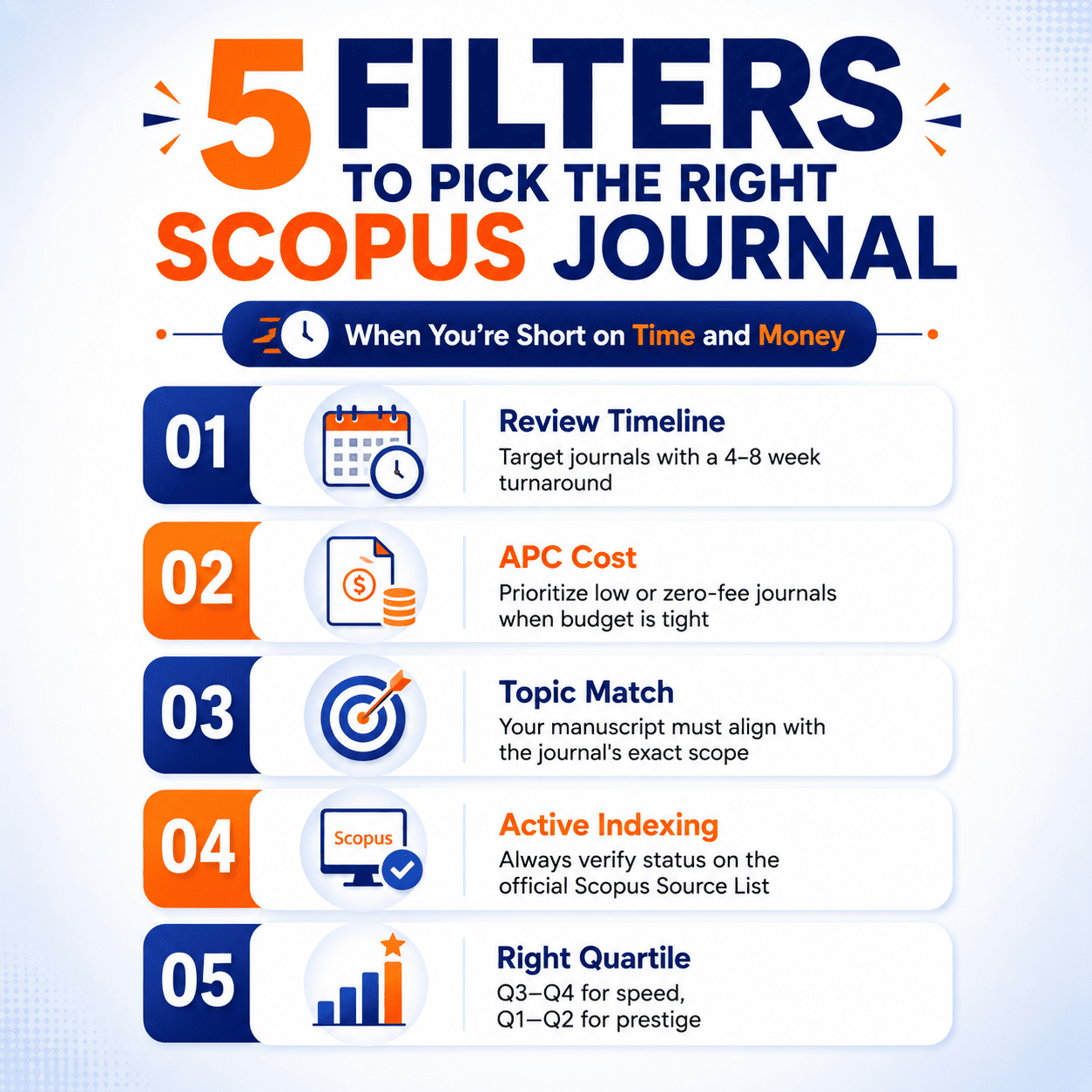
The 5-Filter Framework for Choosing the Right Scopus Journal
Filter 1: Review Timeline — Target 4–8 Weeks
Before submitting, always research a journal’s actual review speed — not the estimate on its homepage.
Use these tools to verify:
- Scimagojr.com — shows publication lag and historical timelines
- JournalGuide.net — aggregates real author-reported review times
- Publons / Web of Science — peer review data by journal
Journals with review cycles under 8 weeks dramatically reduce publication delays. For deadline-driven researchers, this filter alone eliminates half the wrong options.
Filter 2: APC Cost — Low or Zero Fees
Article Processing Charges (APCs) at top journals now average $2,000–$5,000 USD per paper, according to a 2024 PLOS ONE study. This is unsustainable for most researchers working without institutional funding.
Practical alternatives:
- DOAJ (doaj.org) lists thousands of free, peer-reviewed, Scopus-indexed journals
- Many Scopus-indexed journals offer full fee waivers for researchers from low- and middle-income countries
- Hybrid journals offer both open-access and subscription options
Always filter APC cost early — discovering a $3,500 fee after acceptance creates unnecessary pressure.
Filter 3: Topic Match — Niche Over Broad
The biggest mistake researchers make: submitting to journals that are broadly related but not specifically aligned.
A paper on machine learning in healthcare belongs in a medical informatics journal — not a general AI journal. Scope mismatch is the #1 reason for desk rejection without peer review.
How to verify topic match:
- Read the journal’s Aims & Scope carefully
- Check the last 12 months of published articles
- Use Elsevier’s Journal Finder or Springer’s Journal Suggester for automatic matching
Filter 4: Active Indexing — Verify on the Official Scopus Source List
Never assume a journal is still Scopus-indexed. Journals get discontinued or removed regularly.
Always verify directly on the Scopus Source List at: https://www.scopus.com/sources
Warning signs of indexing risk:
- Journal not updated in the Source List within the last 6 months
- Unusually fast publication promises (under 2 weeks)
- No editorial board listed publicly
- Requests for payment before peer review
Publishing in a delisted journal wastes your time and damages your academic profile.
Filter 5: Right Quartile — Match Your Goal, Not Your Ego
Quartile rankings (Q1–Q4) measure a journal’s citation impact within its field, based on SCImago Journal Rank (SJR).
Choose your quartile based on your objective:
| Goal | Best Quartile |
| Fast publication for PhD requirements | Q3–Q4 |
| Grant applications needing track record | Q2–Q3 |
| Career advancement / tenure | Q1–Q2 |
| High-citation visibility | Q1 |
The right quartile is the one that matches your current career stage and deadline — not the most impressive one on paper.
Common Mistakes That Lead to Rejection
- Skipping scope verification and relying on journal name alone
- Submitting to Q1 journals without checking rejection rates (often 70%+)
- Ignoring APC costs until after acceptance
- Never verifying active indexing status
- Choosing review speed based on journal claims, not author-reported data
Action Steps Before Your Next Submission
- Use Scopus Source List to verify indexing status
- Check Scimagojr.com for actual review timelines
- Confirm APCs on the journal’s official website
- Read 5 recent papers in the journal to verify scope fit
- Select your target quartile based on your publication goal
Save this framework. Use it every time.
Which filter do you struggle with most when choosing a journal? Drop your answer in the comments — I read every one.
References
- Scopus Source List: https://www.scopus.com/sources
- SCImago Journal Rankings: https://www.scimagojr.com
- DOAJ (Free journals): https://doaj.org
- Elsevier Journal Finder: https://journalfinder.elsevier.com
- JournalGuide: https://www.journalguide.com
- Springer Journal Suggester: https://journalsuggester.springer.com
- PLOS ONE APC Study 2024: https://plos.org/resource/publication-fees
Want research service from Research & Report experts? Please get in touch with us.