
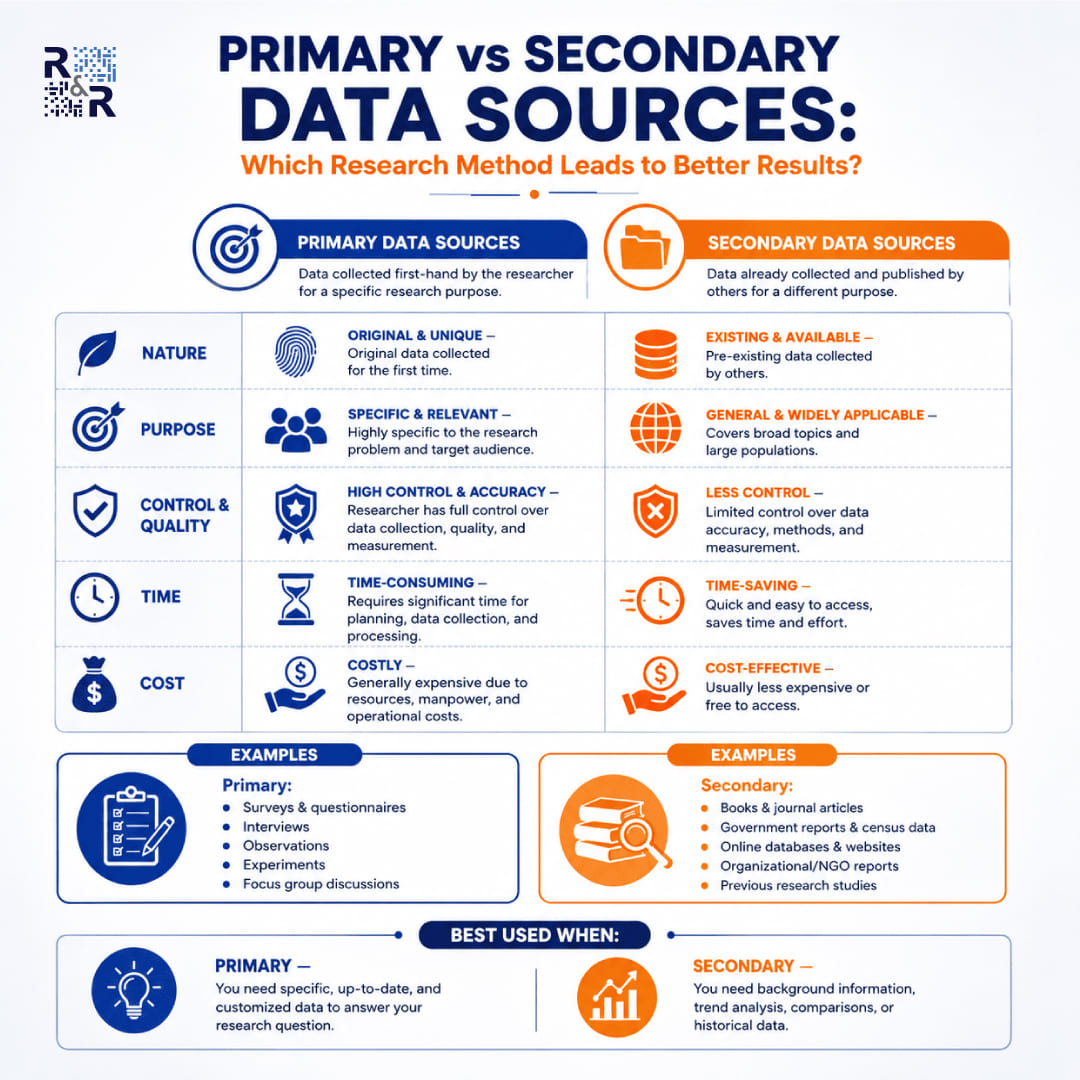
Introduction: Two Paths, One Research Goal
Every research project starts with a critical decision. Do you collect your own data, or use what already exists?
Choosing the wrong method wastes time, budget, and credibility. Choosing the right one accelerates your insights and strengthens your conclusions.
This guide breaks down primary vs secondary data sources — clearly, practically, and with real examples — so you can make the right call every time.
What Is Primary Data?
Primary data is original information collected directly by the researcher. It addresses a specific research question that no existing dataset covers.
Key Characteristics of Primary Data
- It is unique and first-hand — no one else has collected this exact data before.
- It is highly specific to your research problem and target audience.
- The researcher controls collection methods, quality, and measurement.
- It takes more time and financial resources to gather.
Common Primary Data Collection Methods
- Surveys and questionnaires — structured tools for gathering large-scale responses.
- Interviews — in-depth conversations that capture qualitative insight.
- Observations — recording behavior in natural or controlled settings.
- Experiments — controlled tests that establish cause-and-effect relationships.
- Focus group discussions — group sessions that surface opinions and attitudes.
According to the American Psychological Association (APA), surveys remain the most widely used primary research method in social sciences, accounting for over 35% of published empirical studies.
What Is Secondary Data?
Secondary data is information already collected, processed, and published by another party — for a different original purpose.
Key Characteristics of Secondary Data
- It is pre-existing and immediately available.
- It covers broad topics and large populations.
- The researcher has limited control over how it was collected.
- It is generally faster and less expensive to access.
Common Secondary Data Sources
- Books and peer-reviewed journal articles
- Government reports and census databases
- Online databases (JSTOR, PubMed, Statista)
- Organizational and NGO reports
- Previous academic research studies
Primary vs Secondary Data: Head-to-Head Comparison
| Dimension | Primary Data | Secondary Data |
| Nature | Original and unique | Pre-existing |
| Purpose | Highly specific | General and broad |
| Control | Full control | Limited control |
| Time | Time-consuming | Time-saving |
| Cost | Expensive | Cost-effective |
| Best used when | You need custom, current data | You need background or trend data |
Why Control and Accuracy Matter in Research
When you collect primary data, you design the questions, select the sample, and oversee every step. This means fewer hidden biases and higher measurement validity.
Secondary data, by contrast, may contain collection errors, outdated figures, or sampling limitations that you cannot fix. Always evaluate secondary sources critically before relying on them.
The Pew Research Center recommends cross-checking secondary datasets against at least two independent sources to verify consistency.
The Real Cost of Research: Primary vs Secondary
Primary research is significantly more expensive. A typical corporate survey with 1,000 respondents can cost between $15,000 and $50,000 USD, depending on scope and methodology (SurveyMonkey, 2023).
Secondary data, by comparison, is often free or low-cost. Major sources like the World Bank Open Data portal, UN databases, and government census platforms provide extensive datasets at no charge.
For startups and small research teams, secondary data often provides the most practical starting point.
When to Use Primary Data
Use primary data when:
- Your research question is unique and no existing dataset covers it.
- You need current, up-to-date data specific to your audience.
- Accuracy and control are non-negotiable for your conclusions.
- You are conducting product testing, clinical trials, or market validation.
When to Use Secondary Data
Use secondary data when:
- You need background context or historical trend analysis.
- Time and budget are constrained.
- You are conducting literature reviews or comparative studies.
- You want to validate primary findings against broader datasets.
The Power of Combining Both Methods
The strongest research uses both. This approach is called mixed-methods research, and it is increasingly standard in academic and commercial settings.
A 2022 meta-analysis published in the Journal of Mixed Methods Research found that studies combining primary and secondary data produced significantly more reliable conclusions than single-method designs.
Example workflow:
- Start with secondary data to understand the landscape and identify gaps.
- Design primary research to fill those gaps with specific, original data.
- Cross-validate your primary findings against secondary benchmarks.
Conclusion
Neither primary nor secondary data is universally better. Each serves a different purpose, and the most credible research uses both strategically.
Primary data gives you precision and control. Secondary data gives you speed and breadth. Together, they give you the full picture.
Over to you: Do you rely more on primary or secondary data in your research — and what’s the biggest challenge you face with each? Share your experience in the comments below.
Need research service from Research & Report experts? Please get in touch with us.
References
- American Psychological Association. Research Methods. https://www.apa.org/research/responsible/research
- Pew Research Center. Our Methods. https://www.pewresearch.org/our-methods/
- World Bank Open Data. https://data.worldbank.org
- SurveyMonkey. Survey Cost Guide. https://www.surveymonkey.com/mp/survey-cost/
- Journal of Mixed Methods Research (SAGE). https://journals.sagepub.com/home/mmr
- United Nations Data Portal. https://data.un.org
- JSTOR. https://www.jstor.org
- Statista. https://www.statista.com