
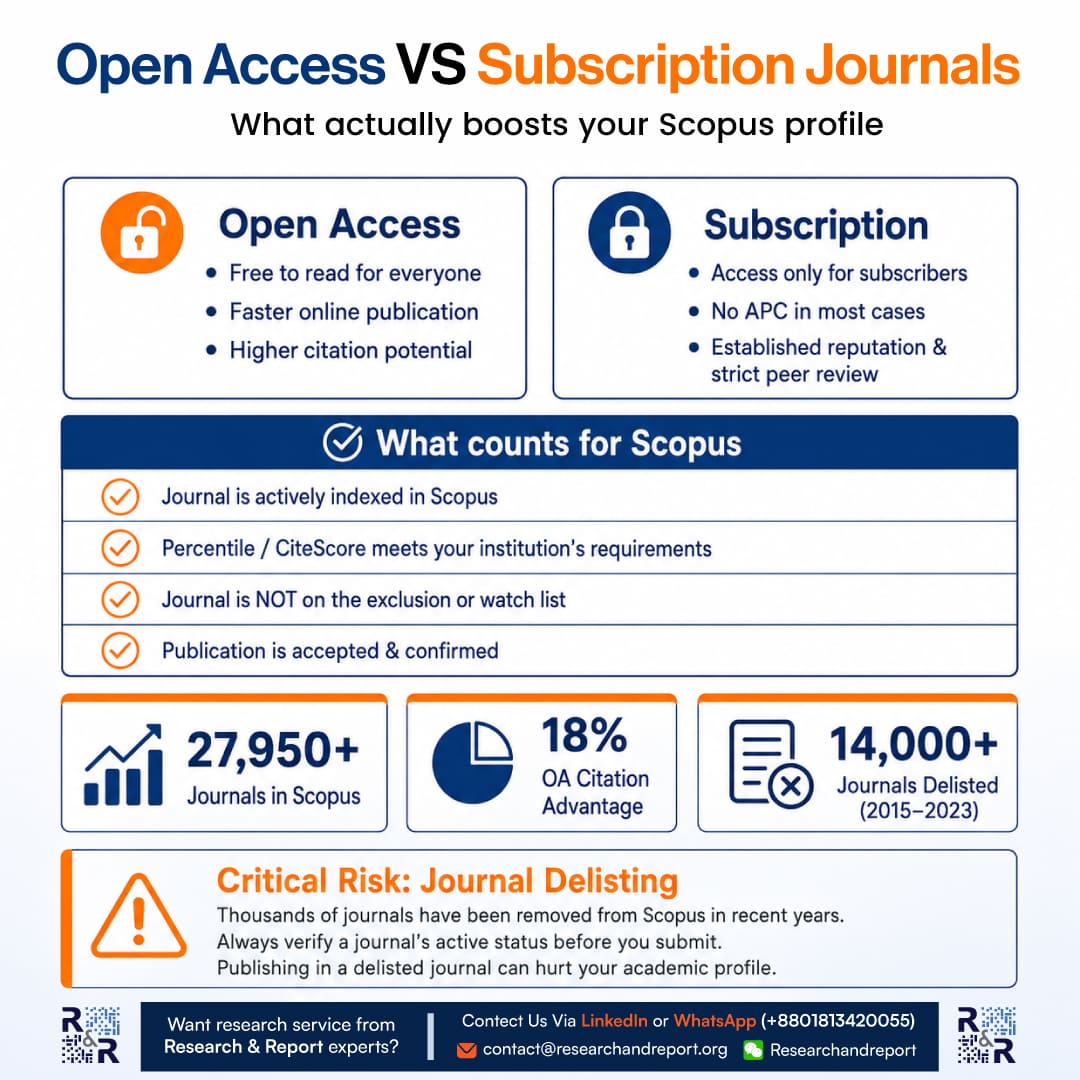
Open Access vs Subscription Journals — What Actually Boosts Your Scopus Profile
Most researchers spend weeks debating journal type before submitting. They ask: “Is open access better for my Scopus profile?” They are asking the wrong question entirely.
The journal type — open access or subscription — does not determine your Scopus standing. Active, verified indexing does. This article breaks down exactly what matters, what most researchers overlook, and how to protect your academic profile with evidence-backed strategies.
What is Scopus and why does it matter?
Scopus is Elsevier’s abstract and citation database. It currently indexes over 27,000 peer-reviewed journals across science, technology, medicine, social sciences, and humanities (Elsevier, 2024). It is the most widely used database for researcher evaluation in institutional rankings, promotion decisions, and funding applications globally.
Your Scopus profile tracks your h-index, citation count, document count, and field-weighted citation impact (FWCI). Institutions in Asia, the Middle East, and Europe especially rely on Scopus metrics for hiring and tenure decisions.
Open Access vs Subscription — the citation advantage debate
Does Open Access really get more citations?
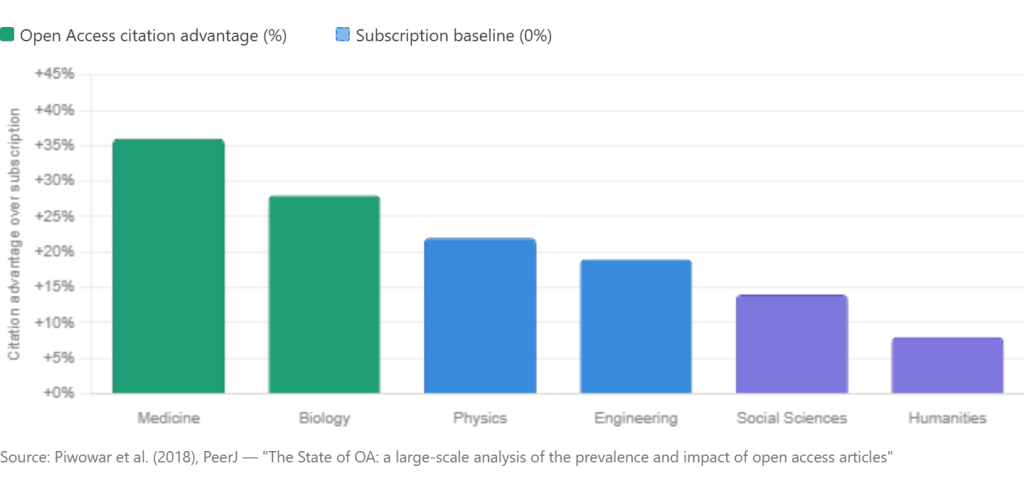
Research strongly supports a citation advantage for OA publications. A landmark study by Piwowar et al. (2018) analyzed over 100,000 papers. It found OA articles receive 18% more citations on average than paywalled equivalents. In some fields, this advantage reaches 36%.
However, this advantage is not guaranteed. It depends on:
- Discipline (STEM fields benefit more than humanities)
- Journal prestige and reputation
- Whether the OA journal is genuinely indexed and actively read
- Author’s existing network and visibility
So OA can boost your citations — but only if you publish in a credible, indexed venue.
The Scopus indexing crisis most researchers ignore
Journals get delisted — and your papers vanish with them
Between 2015 and 2023, Scopus removed approximately 14,000 journals from its active index (Tennant et al., 2019; Scopus policy records). Papers published in delisted journals disappear from researcher profiles — silently, without notification.
This is the single most critical risk in academic publishing today. Yet most researchers never check indexing status after submission.
The “Scopus-indexed” claim trap
Many journals advertise themselves as “Scopus-indexed” on their websites. This claim is frequently:
- Outdated (the journal was indexed but has since been removed)
- Misleading (the journal is under review or on a watchlist)
- Fraudulent (predatory journals falsely claim Scopus indexing)
The only authoritative source is the official Scopus Source List at sources.scopus.com. Always verify there — never trust the journal’s own claim.
Predatory journals and the disappearing paper problem
Predatory journals occasionally appear in Scopus briefly before removal. Researchers who publish in them face a double loss: wasted APCs and papers that vanish from their profiles. The Directory of Open Access Journals (DOAJ) and Beall’s List remain the most reliable cross-checks for OA journal legitimacy.
What CiteScore and percentile actually mean for your profile
CiteScore — the metric institutions use
CiteScore measures the average citations received by a journal’s documents over a four-year window. It replaced the older Impact Factor as Scopus’s primary quality signal. Most institutions now set a minimum CiteScore or percentile threshold for counting a publication in promotion or grant applications.
Key points to know:
- A CiteScore of 1.0 means each paper receives one citation on average per year
- Percentile rank (e.g., top 25%) is often more meaningful than raw score, as it accounts for field norms
- A journal in the 90th percentile in a small field may carry more institutional weight than a CiteScore 3.0 journal in a crowded field
Always check your institution’s specific policy — not just whether a journal is indexed, but whether its CiteScore qualifies.
The watchlist — a hidden trap
Scopus maintains a separate watchlist of journals under review for quality concerns. Papers in watchlisted journals may be counted today and removed tomorrow. As of 2023, Scopus has placed hundreds of journals under review, many of them MDPI and Frontiers titles, though decisions vary by individual journal title. Always check for watchlist status at the Scopus source page.
The 5-step pre-submission verification protocol
Before you submit any manuscript, complete this verification process:
- Go to sources.scopus.com — search by ISSN, not just journal name
- Confirm the status field shows “Active” — not “Inactive,” “Discontinued,” or “Under Review”
- Record the CiteScore and percentile — confirm it meets your institution’s minimum
- Cross-reference: for OA journals, check DOAJ; for all journals, check the ISSN Portal
- After publication, confirm the paper appears in Scopus within 8–12 weeks
This takes under 10 minutes. It can save years of wasted effort.
Open Access models — not all OA is equal
Gold OA
The author pays an APC. The paper is immediately open. Examples: PLOS ONE, Nature Communications. APCs range from $500 to $5,000+.
Green OA (self-archiving)
The author deposits a preprint or accepted manuscript in a repository (arXiv, institutional repository). No APC is required. The journal version may still be paywalled.
Diamond OA
No APC and no subscription fee. Funded by institutions or consortia. Examples: Open Library of Humanities, many society journals. This is the fastest-growing and most equitable OA model.
Hybrid journals
Subscription journals that offer OA as a paid option per article. Scopus counts these the same as fully OA or subscription papers — only the indexing status matters.
Expert recommendations for maximizing your Scopus profile
- Always prioritise indexing status over journal type or prestige signalling
- Use Scopus Source List as your primary pre-submission checkpoint — bookmark it
- Request a waiver for APCs if your institution is in a low-income country (most major publishers offer these)
- Archive a preprint on arXiv, Zenodo, or your institutional repository for any paywalled submission
- Monitor your Scopus author profile quarterly — flag any missing papers immediately via Scopus Author Feedback Wizard
- Never rely on a journal’s own website to confirm indexing — always verify independently
References
- Piwowar, H. et al. (2018). “The State of OA: a large-scale analysis of the prevalence and impact of open access articles.” PeerJ, 6, e4375. https://doi.org/10.7717/peerj.4375
- Tennant, J. et al. (2019). “A multi-disciplinary perspective on emergent and future innovations in peer review.” F1000Research. https://doi.org/10.12688/f1000research.12037.3
- Elsevier Scopus (2024). Scopus Source List and content policy. https://www.elsevier.com/solutions/scopus/how-scopus-works/content
- DOAJ — Directory of Open Access Journals (2024). https://doaj.org
- OurResearch / Unpaywall (2023). Open Access trends data. https://ourresearch.org
- Scopus Author Feedback Wizard. https://www.scopus.com/feedback/author/
Question
Have you ever had a paper disappear from your Scopus profile after a journal was delisted — or discovered a journal’s “Scopus-indexed” claim was false? Share your experience below, or ask your biggest question about publishing strategy. Your insight could help another researcher avoid a costly mistake.
Want research service from Research & Report experts? Please get in touch with us