
What Is Scopus CiteScore?
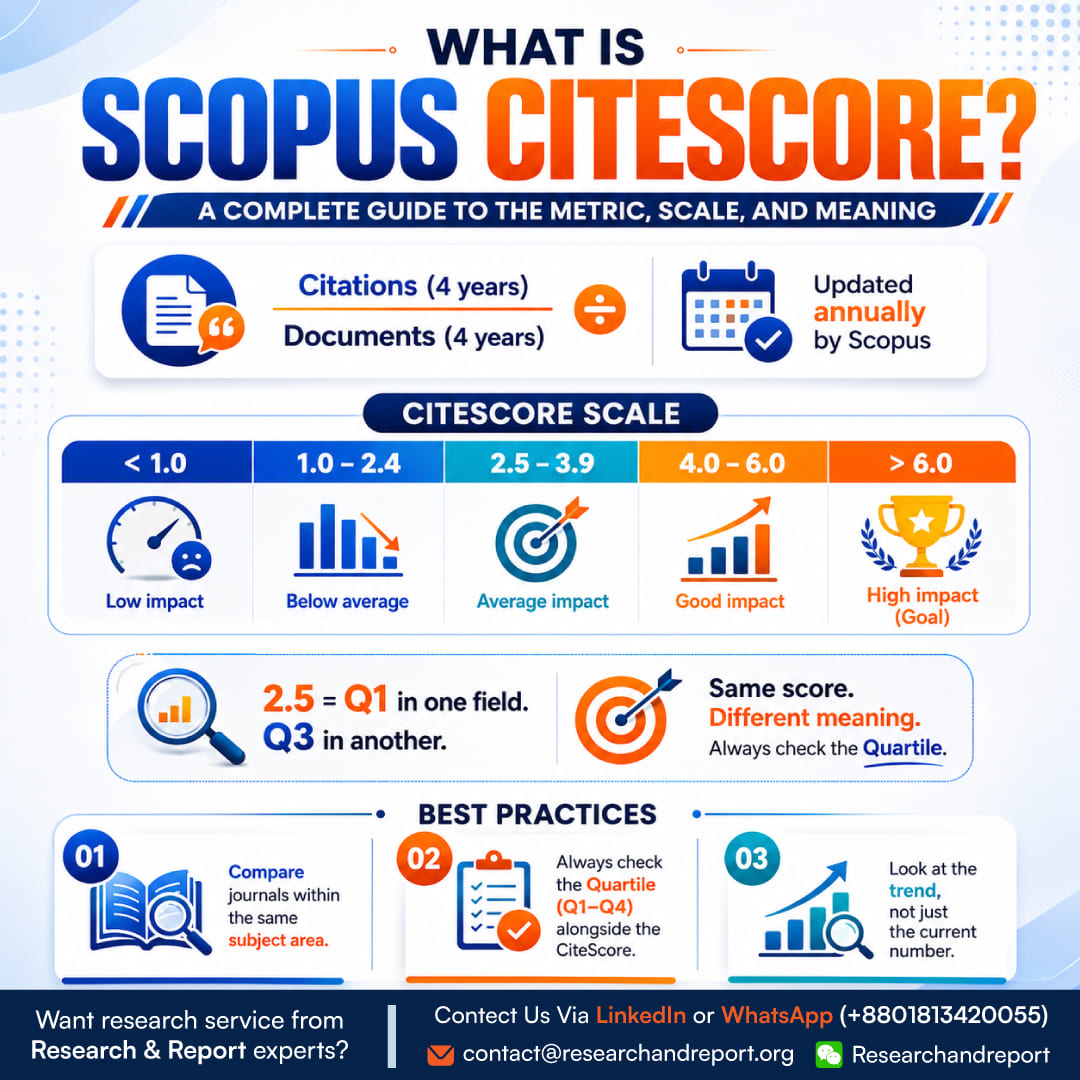
Scopus CiteScore is an open, freely accessible journal-level metric developed by Elsevier. It answers one question: how many times, on average, are a journal’s recent documents cited? Because it uses a four-year window — longer than the two-year Journal Impact Factor (JIF) — it captures citation patterns in fields where research takes longer to accumulate references, such as engineering, mathematics, and the social sciences.
Unlike the JIF, CiteScore counts all document types (articles, reviews, conference papers, book chapters) in both the numerator and denominator. This makes it more transparent and harder to game through editorial document-type manipulation.
How Is CiteScore Calculated?
The formula is straightforward. Scopus sums every citation received in a given year by documents published in the preceding four years, then divides by the total number of those documents.
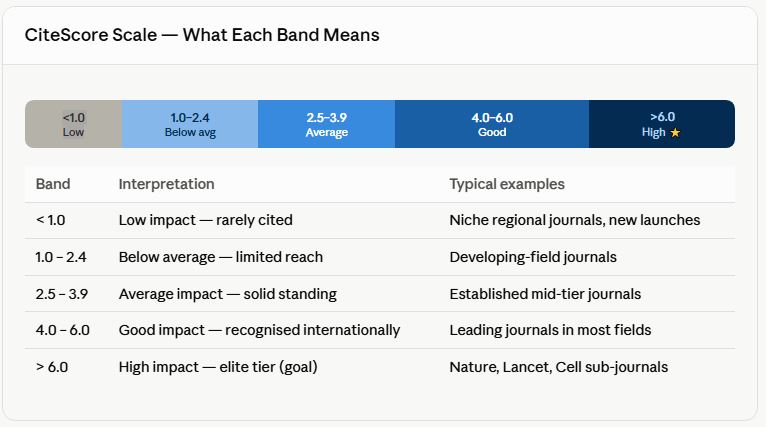
CiteScore vs. Journal Impact Factor — Key Differences
Many researchers confuse CiteScore with the Journal Impact Factor. Both measure citation rates, but they differ in three critical ways: window length, document coverage, and accessibility.
| Feature | Scopus CiteScore | Journal Impact Factor |
| Citation window | 4 years | 2 years |
| Document types counted | All types | Articles & reviews only |
| Freely accessible | Yes (Scopus) | Subscription required (Clarivate) |
| Database source | Scopus | Web of Science |
| Update frequency | Annual | Annual |
Why the Same CiteScore Means Different Things in Different Fields
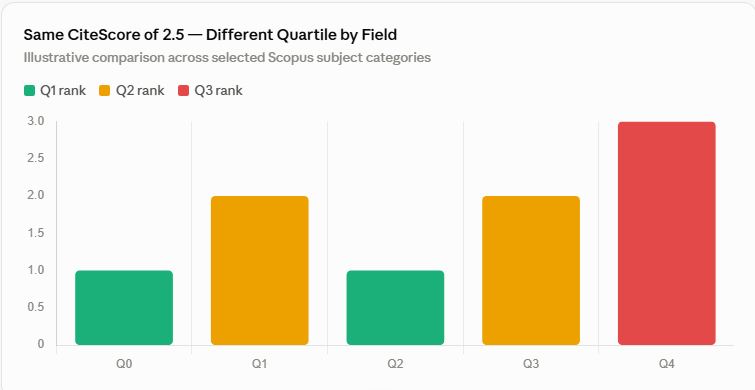
This is the most important concept researchers miss. A CiteScore of 2.5 can place a journal in Q1 (top 25%) in mathematics — a field with slower citation rates — but in Q3 in biomedical sciences, where citation rates are much higher.
Scopus assigns each journal a Quartile rank (Q1–Q4) within its specific subject category. Q1 is the top 25%; Q4 is the bottom 25%. Always check the quartile alongside the raw score.
3 Rules Every Researcher Must Follow

How to Find a Journal’s CiteScore
- Go to scopus.com/sources (free access without login for basic data).
- Search the journal name or ISSN in the search bar.
- Click the journal title — CiteScore, Quartile, and trend data appear on the journal profile page.
- Use the CiteScore Tracker tab to see real-time estimates before the annual update.
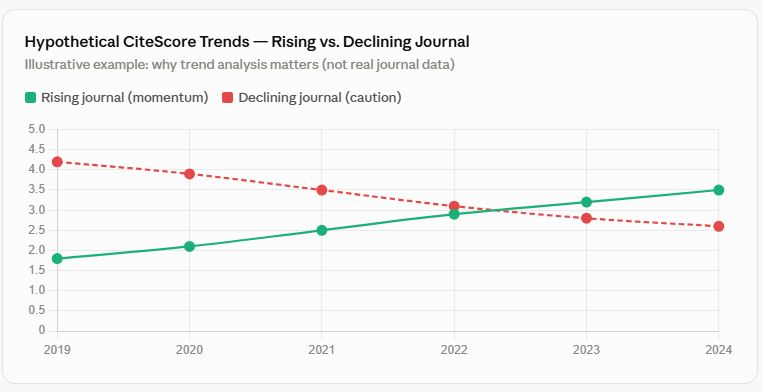
Trend Chart — Why Trajectory Matters More Than a Single Number
A journal with a CiteScore rising from 1.8 to 3.5 over five years signals momentum. Editors are improving quality, the field is growing, or indexing coverage has expanded. A declining trend, even from a comfortable score, warrants caution before submission.
CiteScore and Open Access Journals
Open access (OA) journals often show CiteScore growth faster than subscription journals. Because OA articles face no download barriers, they accumulate citations more quickly — particularly in developing countries. If you submit to an OA journal, verify its CiteScore trend alongside its DOAJ listing and absence from Beall’s list of predatory publishers.
References
Elsevier. (2024). CiteScore metrics: Overview and methodology. elsevier.com
Scopus. (2024). Source search and CiteScore data. scopus.com/sources
Clarivate Analytics. (2024). Journal Citation Reports — Impact Factor methodology. clarivate.com
Zijlstra, H., & McCullough, R. (2016). CiteScore: A new metric to help you choose the right journal. Elsevier Connect. elsevier.com/connect
Thelwall, M. (2018). CiteScore: An acceptable bibliometric indicator? Scientometrics, 116, 629–636. link.springer.com
Over to you: What CiteScore does your target journal have — and did checking the Quartile change how you see it? Drop your field and score below. Let’s compare notes.
Want research service from Research & Report experts? Please get in touch with us