
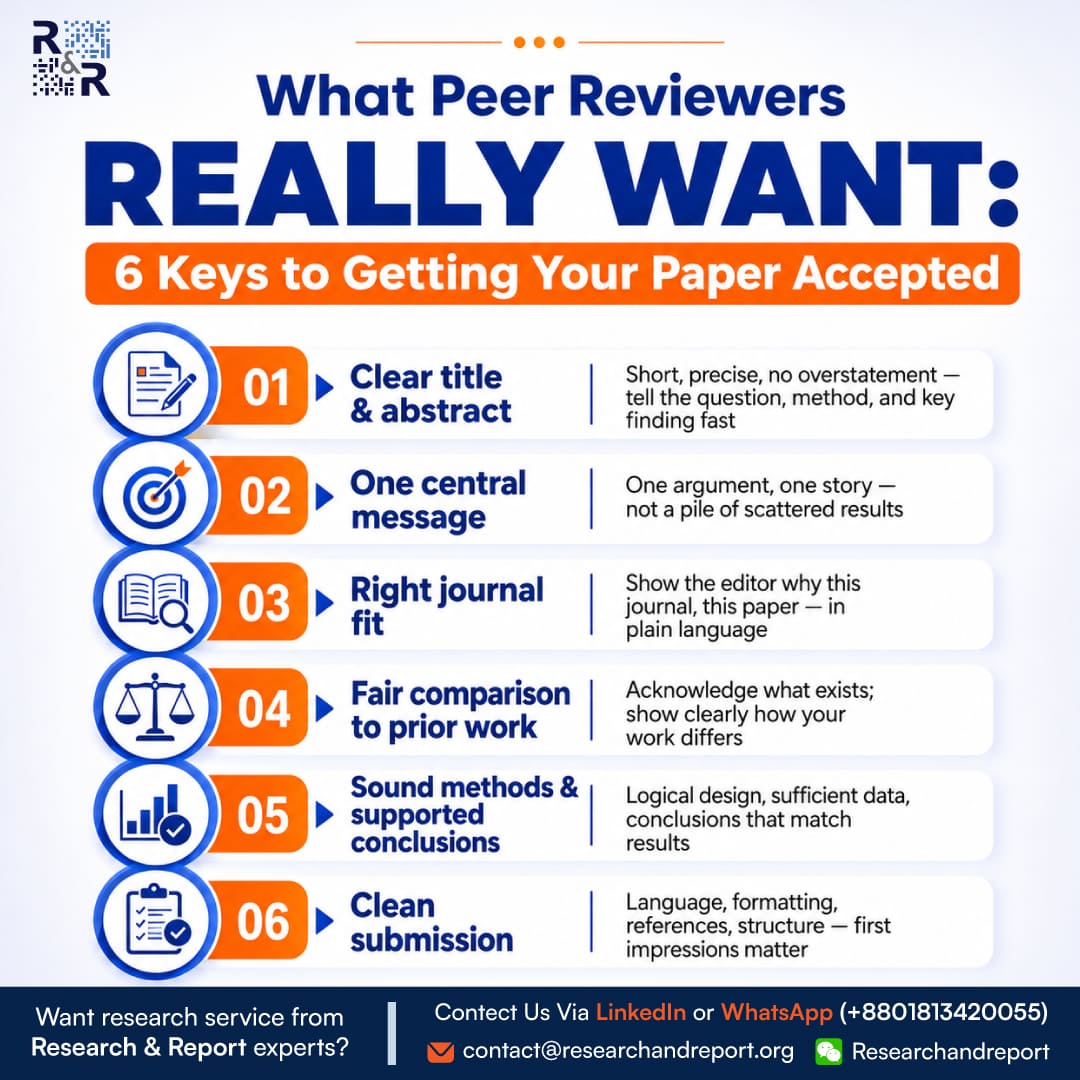
Getting published is not simply about having great research. It is about presenting that research in a way reviewers can easily evaluate and recommend. Studies show that up to 40–60% of submitted papers never reach external peer review at top journals. They are desk-rejected by editors in days (Wiley Peer Review Survey, 2019).
The researchers who publish consistently share one trait: they write for reviewers, not just for themselves. This guide breaks down exactly what peer reviewers look for — with practical guidance, data, and a submission checklist you can use today.
Why Most Papers Fail Before a Reviewer Reads Them
Most authors assume their paper fails at peer review. In reality, it often fails before review begins. Editors make fast decisions based on scope, clarity, and fit. A paper that does not immediately signal its relevance and quality gets returned without external evaluation.
The desk rejection problem
According to the Publons Global State of Peer Review report (2018), reviewers collectively spend over 68 million hours annually evaluating manuscripts. Yet a large proportion of that time is wasted on papers that were never suitable for the target journal. Editors now apply rapid quality filters. Your abstract, title, and cover letter must do heavy lifting before any reviewer sees your methodology.
The 6 Things Peer Reviewers Actually Evaluate
01 — A clear title and abstract
Your title and abstract are your paper’s first impression. Reviewers often decide their initial stance within 60 seconds of reading. A clear title names the topic, method, and scope. A strong abstract answers four questions fast: What is the problem? What did you do? What did you find? Why does it matter?
Avoid vague, overreaching titles. Belcher (2019) notes that overstated titles trigger instant skepticism in experienced reviewers. Keep it precise, honest, and informative.
02 — One central message
Reviewers lose confidence when a paper tries to make five arguments at once. Every strong published paper has one central claim. Everything else — your background, methodology, results, discussion — must support that single argument.
Before submitting, write this sentence: “This paper argues that [X], using [method], and finds [Y].” If you cannot complete it cleanly, your paper is not ready.
03 — The right journal fit
Editors reject papers that are technically sound but wrong for their audience. This decision often takes under 10 minutes. Demonstrate journal fit explicitly in your cover letter. Reference recent papers from that journal. Explain why your work belongs in that specific publication — not just in the field.
Elsevier’s reviewer guidelines (2023) confirm that scope mismatch is among the top reasons editors return papers without review. Do not assume fit — argue for it.
04 — Fair comparison to prior work
Reviewers are experts in your field. They know the literature. If your paper ignores key prior work, or misrepresents what others have found, reviewers will notice immediately. This signals either carelessness or intellectual dishonesty — both are fatal.
Engage critically with existing research. Acknowledge limitations in prior work fairly. Then show — clearly and confidently — what your study adds. Creswell and Creswell (2018) describe this as the foundational move of any credible research contribution.
05 — Sound methods and supported conclusions
Your conclusions must match your data — not exceed it. Reviewers scrutinize the logic chain: Does the design answer the research question? Is the sample sufficient? Do the findings actually support what the author claims?
Overclaiming is one of the most common and damaging errors. The Wiley Peer Review Survey (2019) found that 57% of reviewers cite overclaimed conclusions as a major reason for rejection. State what your data supports. Acknowledge limitations honestly.
06 — A clean submission
Language errors, inconsistent formatting, broken references, and structural problems all signal that the author did not care enough to prepare. This damages reviewer confidence before the science is even evaluated.
Proof-read three times. Use a reference manager. Follow the journal’s author guidelines precisely. Ask a colleague to read the manuscript before submission. First impressions in academic publishing are manuscript impressions.
What the Data Says: Peer Review by the Numbers
- 63% of published papers undergo at least one revision before acceptance (Web of Science Author Report, 2023)
- The average time to first decision for desk rejections is 21 days
- Top-tier journals desk-reject 40–60% of submissions
- 68% of reviewers cite poor writing clarity as a major rejection factor (Publons, 2018)
- 54% of reviewers flag wrong journal scope as a primary concern
Common Mistakes That Guarantee Rejection
- Writing an abstract that summarizes without telling the finding
- Submitting to a journal without reading its scope statement
- Ignoring contradictory studies in the literature review
- Running the right analysis but drawing conclusions the data cannot support
- Submitting with formatting errors or incomplete references
Expert Checklist Before You Submit
Use this checklist on every manuscript before hitting submit:
- Does your title name the topic, method, and scope clearly?
- Can you state your central argument in one sentence?
- Have you read the journal’s aims and scope in the last 30 days?
- Have you cited the key papers from that journal in recent years?
- Does your discussion only claim what your results demonstrate?
- Have you had at least one colleague review the full manuscript?
- Are your references complete, consistent, and correctly formatted?
- Does your cover letter explicitly argue for journal fit?
References
- Wiley (2019). Peer Reviewer Survey: What Reviewers Want. https://authorservices.wiley.com/Reviewers/journal-reviewers/what-is-peer-review
- Publons (2018). Global State of Peer Review. https://publons.com/static/Publons-Global-State-Of-Peer-Review-2018.pdf
- Elsevier (2023). Reviewer Guidelines. https://www.elsevier.com/reviewers/what-is-peer-review
- Creswell, J. W. & Creswell, J. D. (2018). Research Design (5th ed.). SAGE. https://us.sagepub.com/en-us/nam/research-design/book253657
- Belcher, W. L. (2019). Writing Your Journal Article in Twelve Weeks (2nd ed.). University of Chicago Press. https://press.uchicago.edu/ucp/books/book/chicago/W/bo35713405.html
- Web of Science (2023). Global Author Report. https://clarivate.com/webofsciencegroup/campaigns/global-author-report
Frequently Asked Questions
How long does peer review take on average? Most journals take 4–8 weeks for a first decision after external peer review begins. Desk rejections are typically returned within 7–21 days.
Can a paper be rejected after revision? Yes. Reviewers can recommend rejection after seeing a revised manuscript if the revisions do not adequately address their concerns.
What is the most common reason for desk rejection? Poor journal fit — submitting a paper outside the journal’s stated scope — is the leading cause of desk rejection at most journals.
Over to you: Which of these 6 criteria do you find hardest to get right in your own manuscripts — the central message, the journal fit, or something else? Share your experience in the comments. Your answer could help another researcher avoid their next rejection.
Want research service from Research & Report experts? Please get in touch with us