Research and Report Consultancy

Data Analysis Methods Every Student Should Master
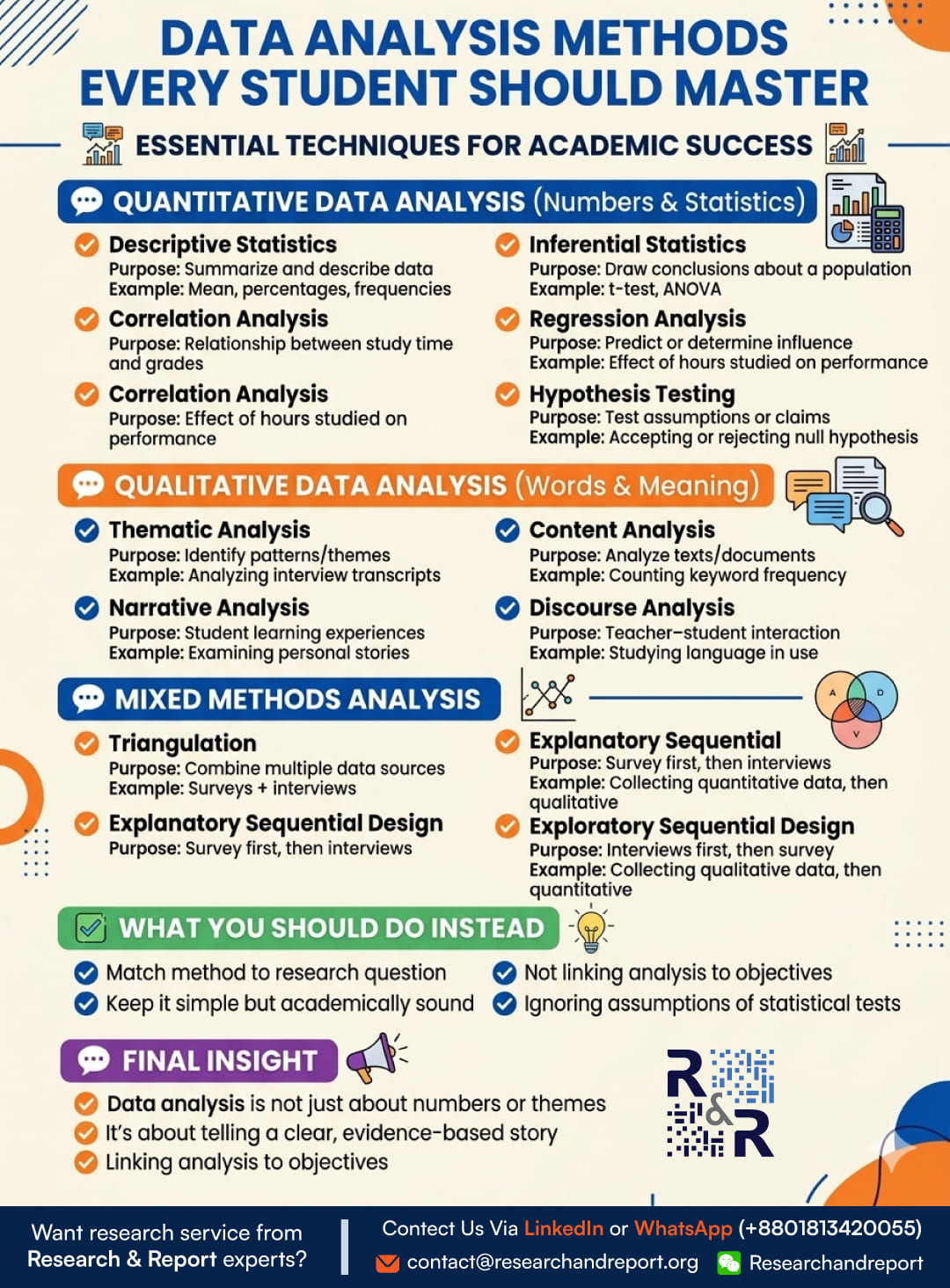
Data-analysis-methods for all students

Many research projects fail due to weak data analysis. Strong ideas alone are not enough. Your findings depend on how well you analyze data. Poor analysis leads to incorrect conclusions and rejection in journals. Therefore, mastering data analysis methods is not optional. It is a core research competency. Types of Data Analysis Methods Quantitative Data … Read more
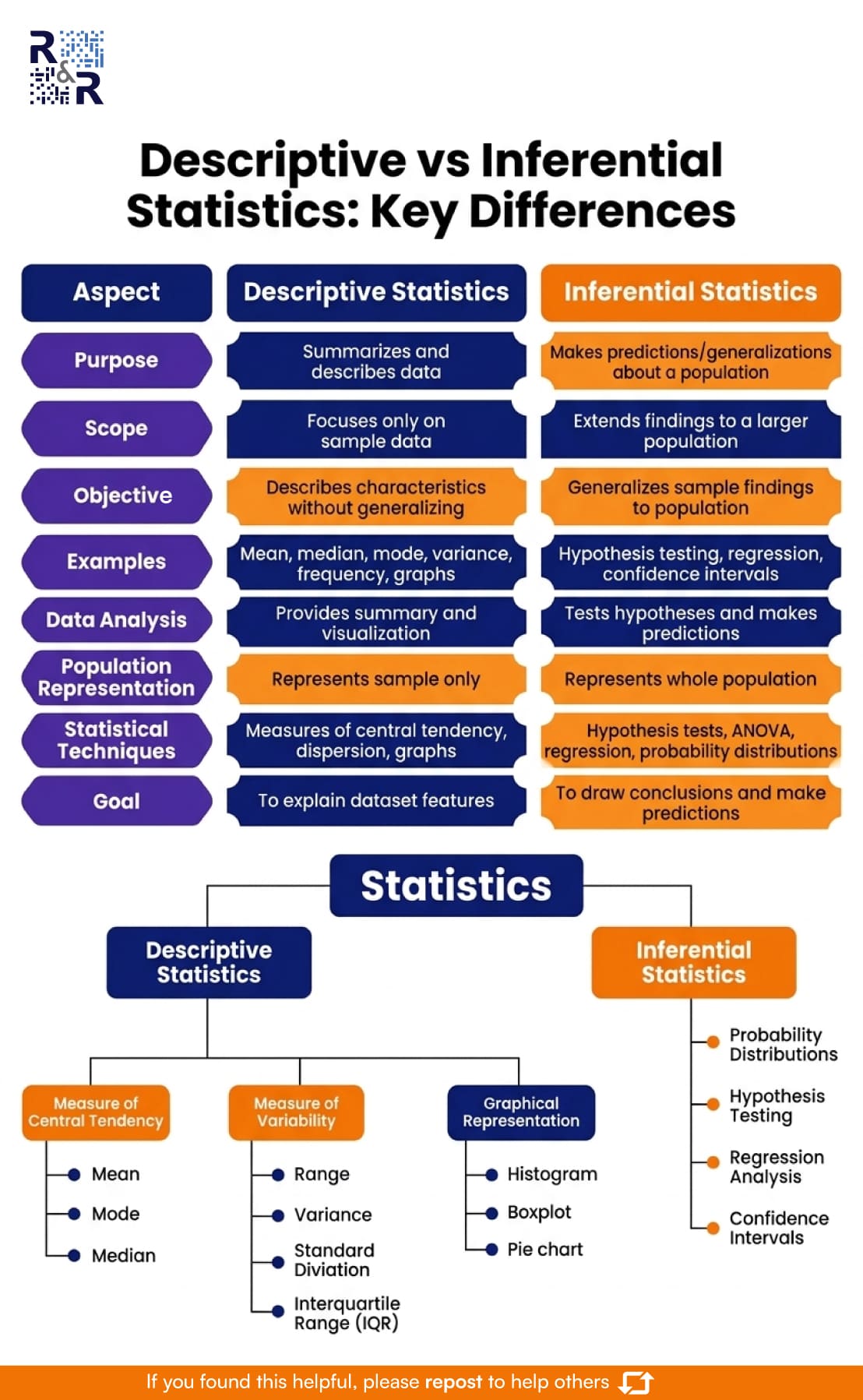
Descriptive vs Inferential Statistics: Key Differences Explained

Descriptive vs Inferential Statistics: Key Differences Explained

Statistics plays a critical role in data analysis, research, business intelligence, and scientific decision-making. Modern organizations rely on statistical methods to interpret data and forecast outcomes. Two primary branches of statistics dominate analytical practice: Both methods work together but serve different purposes. Descriptive statistics explain what the data shows. Inferential statistics predicts what the data … Read more

Why Convenience Sampling Fails Representativeness in Research

Why Convenience Sampling Fails Representativeness in Research

Many studies still confuse convenience sampling with representative sampling. The mistake looks small. But in peer review, it can quietly trigger rejection, credibility loss, and weak evidence claims. Convenience samples come from what is easy to reach. Online forms, single cities, single institutions, social media recruitment, and snowball sampling dominate modern research. These samples can … Read more

Research Without Risk Assessment Is Operationally Vulnerable

Research Without Risk Assessment Is Operationally Vulnerable

Why Research Projects Fail Is Rarely About “Methods” Many research projects do not fail because the theory is weak or the methodology is wrong. They fail because the operational system behind the research breaks down. When risks remain invisible or unmanaged, even the strongest design collapses under real-world constraints. Studies from the NIH, WHO, and … Read more

Why Assuming Variables Are Independent Is Risky

Why Assuming Variables Are Independent Is Risky

Statistical independence is one of the most violated assumptions in social science, economics, public health, and data science. Treating variables—or observations—as independent when they are not can break inference, mislead policymakers, and inflate Type I errors.In real-world datasets, hidden dependence structures arise from clustering, networks, spatial proximity, common raters, and temporal patterns. Ignoring these structures … Read more

Why Many Research Instruments Lack Face Validity—And How to Fix It

Why Many Research Instruments Fail Face Validity

Face validity is the most intuitive—and often the most ignored—dimension of measurement quality. If respondents cannot immediately understand what a question measures, the resulting data become fragile, regardless of high Cronbach’s alpha, AVE, or composite reliability. Poor face validity leads to misinterpretation, satisficing, social desirability distortions, and ultimately flawed statistical conclusions. In reality, many survey … Read more

Why Data Aggregation Masks Inequality and Vulnerability

Why-data-aggregation-masks-inequality-and-vulnerability

Aggregated data often simplifies complex realities into a single number, such as a national poverty rate, an average test score, or a district-level health indicator. While these summaries support fast reporting, they also conceal inequality, mute vulnerability, and distort policy decisions. Policymakers, donors, and researchers frequently rely on aggregated indicators without examining underlying distributions. As … Read more

Gender Dynamics Can Distort Fieldwork Findings

Gender Dynamics Can Distort Fieldwork Findings

Most research projects treat gender as a demographic checkbox rather than a structural force that shapes how data is created. However, gender dynamics influence who speaks, what they share, and whether the information captured reflects lived realities. When gender is ignored during fieldwork, the entire evidence base can quietly become biased—leading to misleading conclusions and … Read more

Why Theories Stay Cited, Not Applied

Why-Theories-Stay-Cited,-Not-Applied

The research world is full of theories—TAM, TPB, SDT, DOI, Social Learning Theory, and more. They appear across dissertations, journal articles, and conference papers. Yet most theories function as cosmetic citations, not analytical frameworks. Researchers cite them for legitimacy, but rarely apply them rigorously. At Research & Report Consulting, our reviews of 500+ academic manuscripts … Read more

How the Unit of Analysis Can Ruin Your Research

How-unit-of-analysis-can-ruin-your-research

Most research failures start long before data analysis. They begin at the design stage, when researchers misidentify the unit of analysis. This single mistake produces misleading results, faulty comparisons, and policy recommendations that collapse when applied in real-world settings. For research, evaluation, and policy studies, choosing the wrong unit of analysis is one of the … Read more