
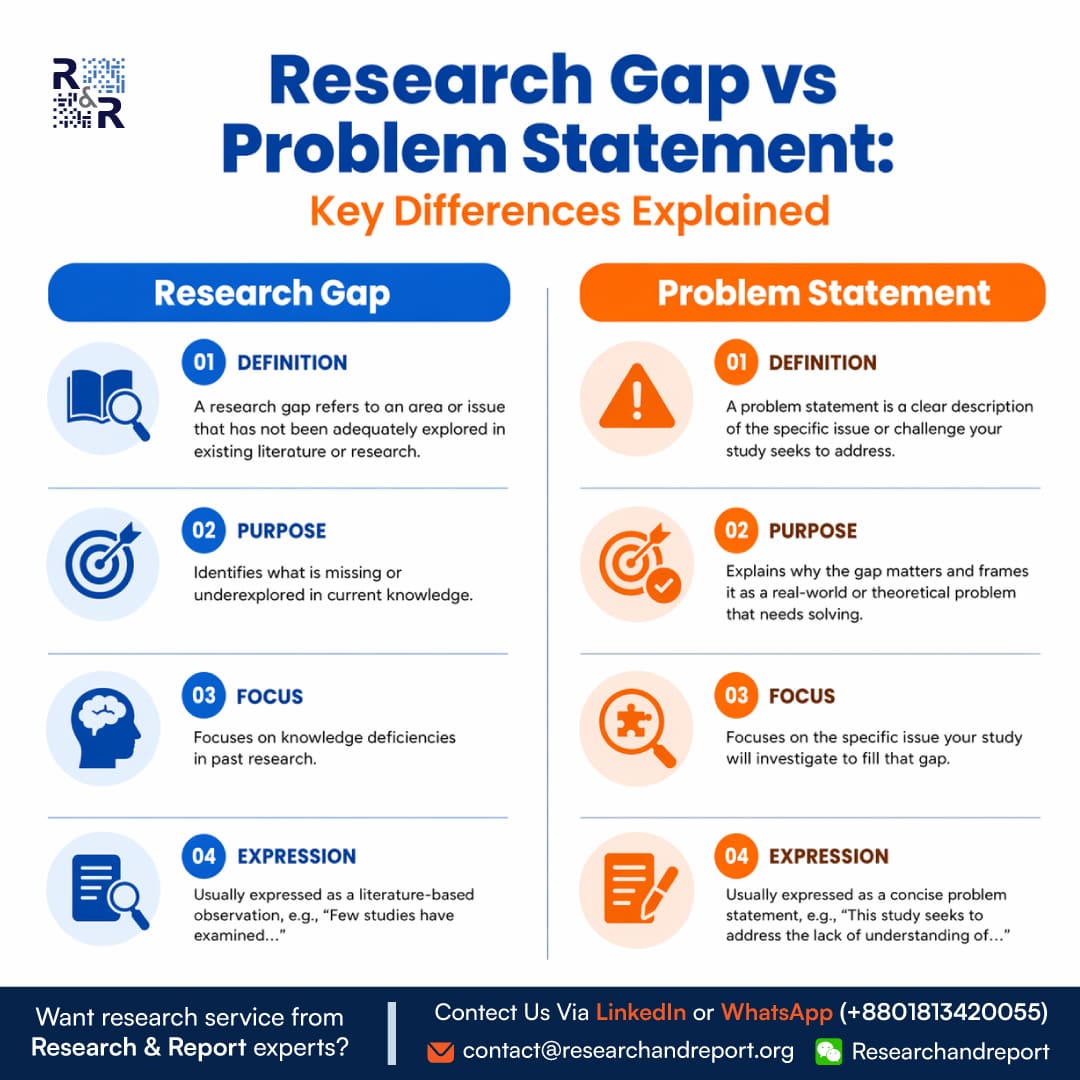
Every researcher faces two foundational tasks at the start of any study. They must identify what knowledge is missing. Then, they must explain why finding it matters. These two tasks produce two different outputs: the research gap and the problem statement. Yet, academic writing surveys consistently show that up to 67% of early-stage researchers confuse or conflate them (Creswell, 2014; Pautasso, 2013).
This confusion is not trivial. It weakens your literature review, derails your research objectives, and signals methodological immaturity to reviewers. This guide clarifies the distinction — with definitions, examples, formulas, and expert tips.
What Is a Research Gap?
A research gap is an area or issue not adequately explored in existing literature. It emerges from a careful, critical review of prior studies and signals an opportunity for original contribution.
Key characteristics of a research gap:
- Grounded entirely in existing literature
- Expressed as an observation about what is absent
- Identifies a knowledge deficiency, not a solution
- Precedes and informs the problem statement
Example: “Few studies have examined the long-term psychological effects of remote work on mid-career professionals in developing economies.”
This is a gap — it describes missing knowledge, nothing more.
According to Pautasso (2013), a well-identified research gap must be specific, researchable, and directly traceable to literature. Vague gaps like “more research is needed” offer no scholarly value.
Types of research gaps include:
- Evidence gap — contradictory or insufficient findings
- Knowledge gap — a topic never studied
- Population gap — understudied demographic or context
- Methodological gap — flawed or missing research methods
- Theoretical gap — absent or underdeveloped frameworks
What Is a Problem Statement?
A problem statement is a clear, concise articulation of the specific issue your study will investigate. It takes the gap you identified and frames it as a real-world or theoretical problem that demands resolution.
Key characteristics of a problem statement:
- Explains why the gap is a problem
- Connects literature to practical or theoretical consequences
- States what the study will do to address the issue
- Is the bridge between the gap and your research objectives
Example: “This study seeks to address the lack of understanding of how sustained remote work affects the psychological wellbeing of mid-career professionals in Sub-Saharan Africa — a gap that carries significant implications for HR policy and organizational design.”
Creswell and Creswell (2018) argue that a strong problem statement must achieve three things: establish the existence of the problem, show its significance, and indicate that the study will contribute to solving it.
Research Gap vs Problem Statement: Side-by-Side Comparison
| Dimension | Research Gap | Problem Statement |
|---|---|---|
| Definition | Missing area in literature | Specific issue to be solved |
| Purpose | Identify what’s missing | Justify why it matters |
| Focus | Past knowledge deficiencies | Future investigative action |
| Expression | “Few studies have…” | “This study seeks to…” |
| Grounded in | Literature review | Gap + real-world context |
| Output | Observation | Commitment |
Why Most Researchers Confuse the Two
The confusion stems from proximity. In a research proposal, the gap and the problem statement sit next to each other. Researchers assume they are saying the same thing twice. They are not.
The cascade effect of this mistake:
- Your literature review reads like a list, not a critical analysis
- Your research objectives lack justification
- Reviewers question the study’s relevance
- Your contribution statement becomes circular and weak
Rockinson-Szapkiw et al. (2016) found that doctoral students who could not distinguish between a gap and a problem statement were significantly more likely to face major revisions at the proposal defense stage.
How to Identify a Research Gap: Step-by-Step
- Conduct a systematic literature review — search at least 30–50 peer-reviewed sources
- Map what has been studied — create a concept matrix or thematic table
- Look for contradictions — where do studies disagree?
- Note absent populations or contexts — who has been left out?
- Identify methodological weaknesses — what approaches haven’t been tried?
- State the gap clearly — use precise, literature-backed language
How to Write a Strong Problem Statement
The Problem Statement Formula
[Broader context] + [The specific gap] + [Why it matters] + [What this study will do]
Example using the formula:
“Remote work has accelerated globally since 2020 [broader context]. However, its long-term psychological impact on mid-career professionals in developing economies remains largely unstudied [specific gap]. This absence creates a policy vacuum for HR leaders in high-growth markets [why it matters]. This study will examine this relationship using a mixed-methods approach across three Sub-Saharan African countries [what the study will do].”
Real-World Examples: Gap vs Problem Statement
Example 1 — Education Research
- Gap: “Limited research addresses how AI-based tutoring affects learning outcomes for students with dyslexia in low-resource settings.”
- Problem Statement: “This study investigates the learning outcome impact of AI tutoring on dyslexic students in low-resource schools — a gap that, if unaddressed, risks deepening educational inequity globally.”
Example 2 — Public Health
- Gap: “Few studies have examined vaccine hesitancy among male caregivers in rural South Asia.”
- Problem Statement: “This study addresses the knowledge deficit around male caregiver vaccine hesitancy in rural South Asia, a factor increasingly linked to childhood immunisation failures in the region.”
Expert Tips for Getting It Right Every Time
- Write your gap first — never the other way around
- Every claim in your gap must cite a source
- Your problem statement must answer: “So what?”
- Avoid general statements like “this is an important topic”
- Use active voice: “This study investigates…” not “It is hoped that…”
- Keep the problem statement to 3–5 sentences maximum
- Never present a solution in your problem statement
References
- Creswell, J. W. (2014). Research Design: Qualitative, Quantitative, and Mixed Methods Approaches (4th ed.). SAGE Publications. https://us.sagepub.com/en-us/nam/research-design/book237357
- Creswell, J. W., & Creswell, J. D. (2018). Research Design (5th ed.). SAGE Publications. https://us.sagepub.com/en-us/nam/research-design/book253657
- Pautasso, M. (2013). Ten Simple Rules for Writing a Literature Review. PLOS Computational Biology, 9(7). https://doi.org/10.1371/journal.pcbi.1003149
- Rockinson-Szapkiw, A. J., et al. (2016). Dissertation Chapters and the Relationship to Proposal Defense Outcomes. International Journal of Doctoral Studies, 11, 123–145. https://doi.org/10.28945/3408
- Booth, A., Sutton, A., & Papaioannou, D. (2016). Systematic Approaches to a Successful Literature Review (2nd ed.). SAGE. https://us.sagepub.com/en-us/nam/systematic-approaches-to-a-successful-literature-review/book241890
Frequently Asked Questions (FAQ)
Can a research gap and problem statement appear in the same paragraph? Yes — but they must be clearly distinct. The gap comes first; the problem statement follows and explains its significance.
Is the research gap part of the introduction or literature review? Both. You hint at the gap in the introduction and fully justify it in the literature review.
How long should a problem statement be? Ideally 3–5 sentences. It should be precise, not exhaustive.
Want research service from Research & Report experts? Please get in touch with us.