
Why Most Research Papers Fail
Many researchers face rejection not because of weak ideas, but due to poor structure and clarity. Journals increasingly prioritize logical flow, reproducibility, and contribution clarity.
According to studies in academic publishing, over 60% of rejected manuscripts fail due to structural and presentation issues, not research quality.
A structured framework solves this problem.
The Core Problem in Academic Writing
Most researchers struggle with:
- Lack of a clearly defined research gap
- Weak connection between literature and objectives
- Poor explanation of methods and reproducibility
- Over-reporting results without interpretation
- Generic conclusions lacking real-world impact
These issues reduce credibility and citation potential.
Proven Frameworks for Writing Research Papers
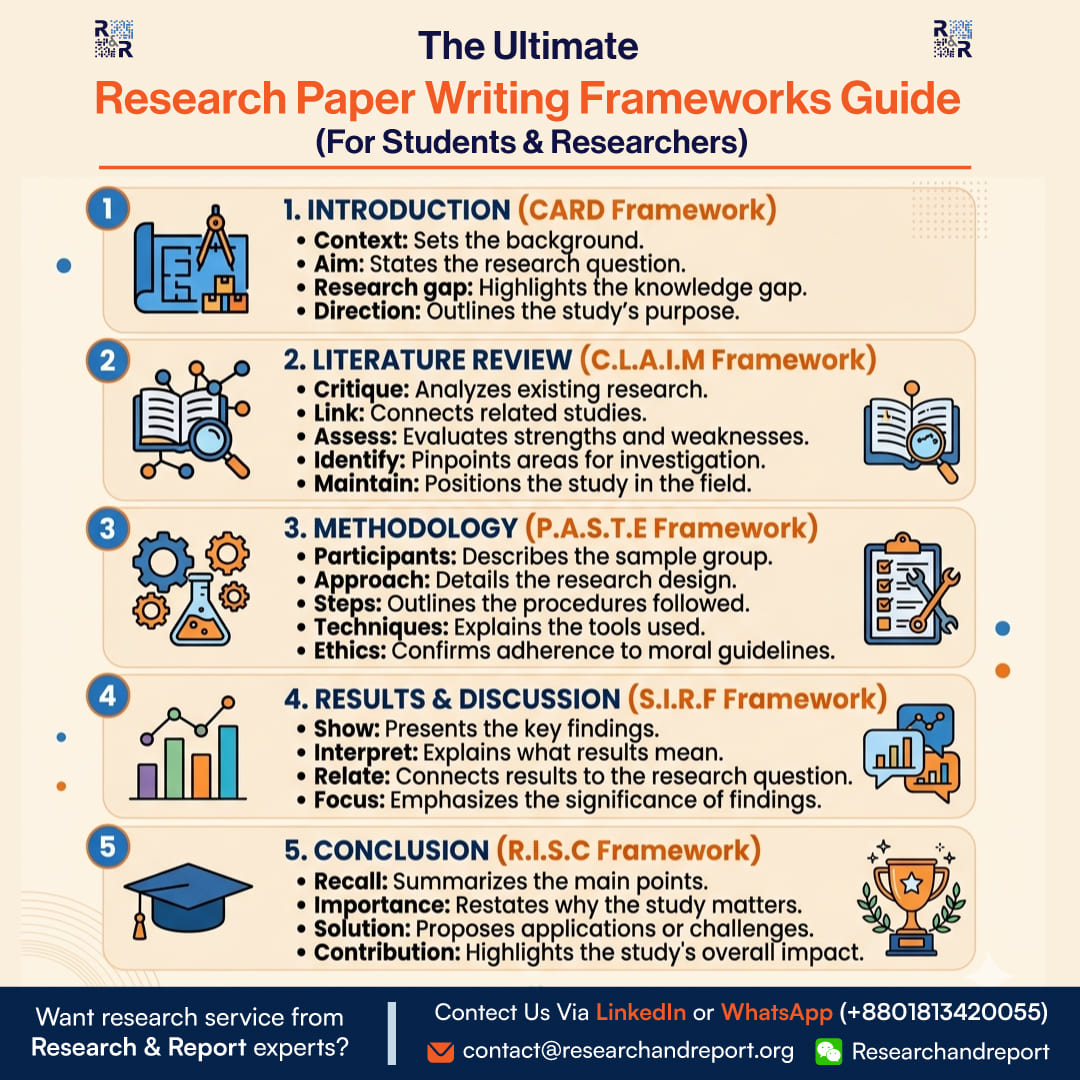
1. Introduction – CARD Framework
The introduction sets the foundation.
- Context: Establish relevance and background
- Aim: Define a precise research question
- Research Gap: Highlight what is missing
- Direction: Outline study purpose
🔎 Critical Insight: Many papers fail because the research gap is vague or implied.
2. Literature Review – C.L.A.I.M Framework
A strong review builds authority.
- Critique: Evaluate existing research
- Link: Connect studies logically
- Assess: Identify strengths and weaknesses
- Identify: Find gaps for exploration
- Maintain: Position your study in the field
📊 Best Practice: Avoid summarizing. Focus on synthesis and argument building.
3. Methodology – P.A.S.T.E Framework
Transparency is essential.
- Participants: Define sample clearly
- Approach: Justify research design
- Steps: Provide replicable procedures
- Techniques: Use validated tools
- Ethics: Ensure compliance
⚠️ Key Issue: Poor methodology clarity leads to low reproducibility, a major rejection factor.
4. Results & Discussion – S.I.R.F Framework
Data alone is not enough.
- Show: Present key findings
- Interpret: Explain meaning
- Relate: Connect to research question
- Focus: Highlight significance
📈 Insight: High-impact papers emphasize interpretation over raw data.
5. Conclusion – R.I.S.C Framework
End with impact.
- Recall: Summarize key points
- Importance: Reinforce significance
- Solution: Provide applications
- Contribution: Highlight originality
🚀 Tip: Avoid repetition. Focus on value and implications.
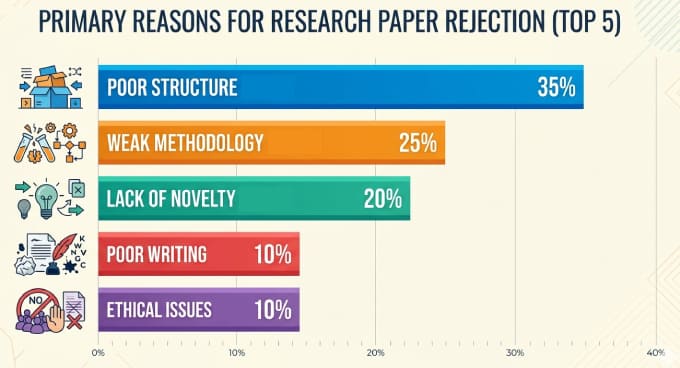
Common Reasons for Paper Rejection
Why Frameworks Improve Publication Success
Frameworks help:
- Improve clarity and readability
- Increase peer reviewer confidence
- Enhance logical argument flow
- Strengthen novelty presentation
- Boost citation potential
Actionable Writing Strategy
To implement effectively:
- Start with research gap clarity
- Map your paper using frameworks
- Align each section with objectives
- Review for logical consistency
- Edit for clarity and brevity
Conclusion
A well-structured research paper increases acceptance probability significantly. These frameworks provide a systematic approach to academic writing.
They are not optional. They are essential.
Question
Which section of your research paper do you struggle with the most—and why?
Want research service from Research & Report experts? Please get in touch with us.
References
- Elsevier Researcher Academy
https://researcheracademy.elsevier.com - Springer Nature Author Guidelines
https://www.springernature.com/gp/authors - Purdue OWL Academic Writing Guide
https://owl.purdue.edu - Nature Masterclasses
https://masterclasses.nature.com - APA Research Paper Structure
https://apastyle.apa.org