
Non-native English speakers produce over 50% of global scientific research. Yet language barriers remain one of the leading causes of desk rejection in Scopus-indexed journals (Flowerdew, 2013). The good news? Academic English is a learnable skill — not a talent.
This guide gives you five research-backed strategies to strengthen your academic writing and get published faster.
Why English Writing Quality Determines Your Scopus Success
Scopus indexes over 25,000 peer-reviewed journals across 330+ disciplines (Elsevier, 2024). Editors receive thousands of submissions annually. Poorly written English signals low professionalism — even when the research is excellent.
According to a study published in PLOS ONE, non-native English-speaking authors are significantly more likely to face rejection at the language review stage than native speakers (Hyland, 2016). One language review can be the difference between acceptance and a desk rejection within 48 hours.
5 Proven Strategies to Improve Academic English for Scopus
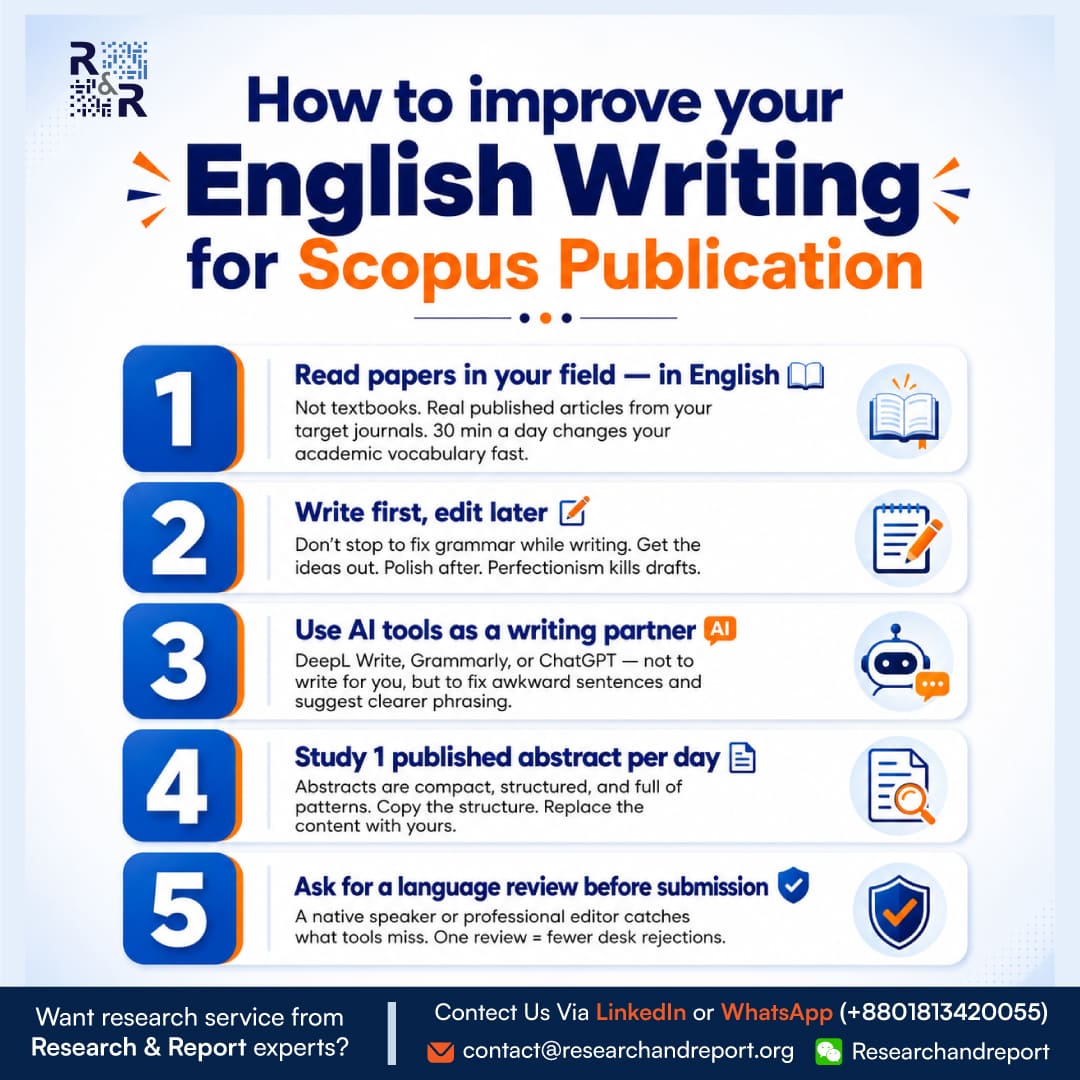
1. Read Real Journal Articles — Not Textbooks
- Target your top 3 Scopus-indexed journals in your field
- Spend 30 minutes daily reading published articles
- Highlight phrases, transitions, and sentence structures you can reuse
- Build a personal vocabulary bank of academic collocations
Why it works: Real articles expose you to authentic academic register — the tone, phrasing, and structure editors expect. Textbooks teach general English; journals teach publishable English.
Recommended resources: ScienceDirect, PubMed, Google Scholar, ResearchGate
2. Write First, Edit Later
Most researchers lose hours staring at blank pages — paralysed by perfectionism.
- Set a 25-minute writing sprint (Pomodoro method)
- Write everything that comes to mind — grammar, structure, clarity come second
- Separate the creative phase from the editing phase entirely
- Use voice-to-text tools like Whisper (OpenAI) if typing in English feels slow
Research insight: A study by Kellogg (1994) found that writers who separate drafting from editing produce higher quality final texts and experience less cognitive overload.
3. Use AI Tools as a Writing Partner
AI writing tools are now essential for non-native English academic writers — but use them correctly:
| Tool | Best For | Free Plan? |
| Grammarly | Grammar, tone, clarity | Yes |
| DeepL Write | Natural phrasing rewrites | Yes |
| ChatGPT / Claude | Sentence restructuring, paraphrasing | Yes |
| Writefull | Academic-specific suggestions | Limited |
| Trinka AI | Scientific writing polish | Yes |
Important: Use AI to improve your writing — not replace it. Journals increasingly use AI detection tools, and authenticity matters.
4. Study One Published Abstract Per Day
Abstracts are the most compressed, structured academic writing in existence.
- Pick one abstract from a top-ranked Scopus journal in your field daily
- Identify the structure: Background → Objective → Methods → Results → Conclusion
- Copy the sentence structure; replace the content with your own research context
- Build a swipe file of 30 abstracts over one month
According to Hyland (2000), abstracts follow highly predictable rhetorical patterns across disciplines — learning these patterns dramatically accelerates your writing speed.
5. Get a Language Review Before Submission
- A professional language editor catches issues AI tools miss — cultural tone, field-specific norms, logical flow
- Use platforms like Editage, Enago, or American Journal Experts (AJE)
- Even one round of editing before submission reduces desk rejections significantly
- Consider peer language exchange with a native-speaking colleague in your field
Elsevier’s own author support data shows that manuscripts with professional language editing have a measurably higher acceptance rate at the pre-review stage.
Common Mistakes That Lead to Desk Rejection
- Overly complex sentences (aim for under 20 words per sentence)
- Passive voice overuse — use active voice wherever possible
- Missing or weak abstract structure
- Inconsistent use of tense (past tense for methods/results; present for conclusions)
- Poor transition words between paragraphs
How Long Does It Take to Improve Academic English?
With 30 minutes of daily practice, most researchers see measurable improvement within 8–12 weeks. Full academic fluency develops over 6–12 months of consistent reading, writing, and feedback.
The compound effect is real. One abstract per day = 365 studied structures per year. That is more academic writing training than most formal courses offer.
References
- Flowerdew, J. (2013). English for Research Publication Purposes. Routledge. https://www.routledge.com
- Hyland, K. (2000). Disciplinary Discourses: Social Interactions in Academic Writing. Longman.
- Hyland, K. (2016). Academic publishing and the myth of linguistic injustice. Journal of Second Language Writing. https://doi.org/10.1016/j.jslw.2016.01.005
- Kellogg, R.T. (1994). The Psychology of Writing. Oxford University Press.
- Elsevier Scopus (2024). Scopus Source List. https://www.scopus.com/sources
- Editage Insights (2024). Why manuscripts get desk rejected. https://www.editage.com/insights
- Writefull (2024). AI tools for academic writing. https://writefull.com
What is your biggest challenge when writing in English for Scopus journals — grammar, structure, vocabulary, or something else? Share below
Want research service from Research & Report experts? Please get in touch with us