
Most researchers don’t get rejected because their work is weak. They get rejected because they submit to the wrong journal. A 2023 analysis by Publons found that scope mismatch alone accounts for roughly 42% of desk rejections — before a single peer reviewer ever reads the paper. Yet most early-career academics still rely on supervisor recommendations or gut instinct when choosing a journal.
That workflow is costing you months. Here’s what to do instead.
Why Journal Selection Is a Critical Research Skill
Every wrong submission costs 8–16 weeks. Reformat. Resubmit. Repeat. Meanwhile, the right journal — one aligned to your paper’s scope, audience, and indexing tier — was always searchable in under five minutes.
The challenge isn’t finding journals. There are over 10,000 active journals indexed in Scimago alone. The challenge is finding the right one efficiently, and verifying it is legitimate before you invest time.
This guide covers 12 free, reputable tools that researchers can use today — grouped by use case, with honest guidance on when to use each one.
Publisher-Specific Journal Finder Tools
These tools are built and maintained by major academic publishers. They are most useful after you have confirmed your topic’s general scope and are ready to narrow down to a specific publisher’s catalog.
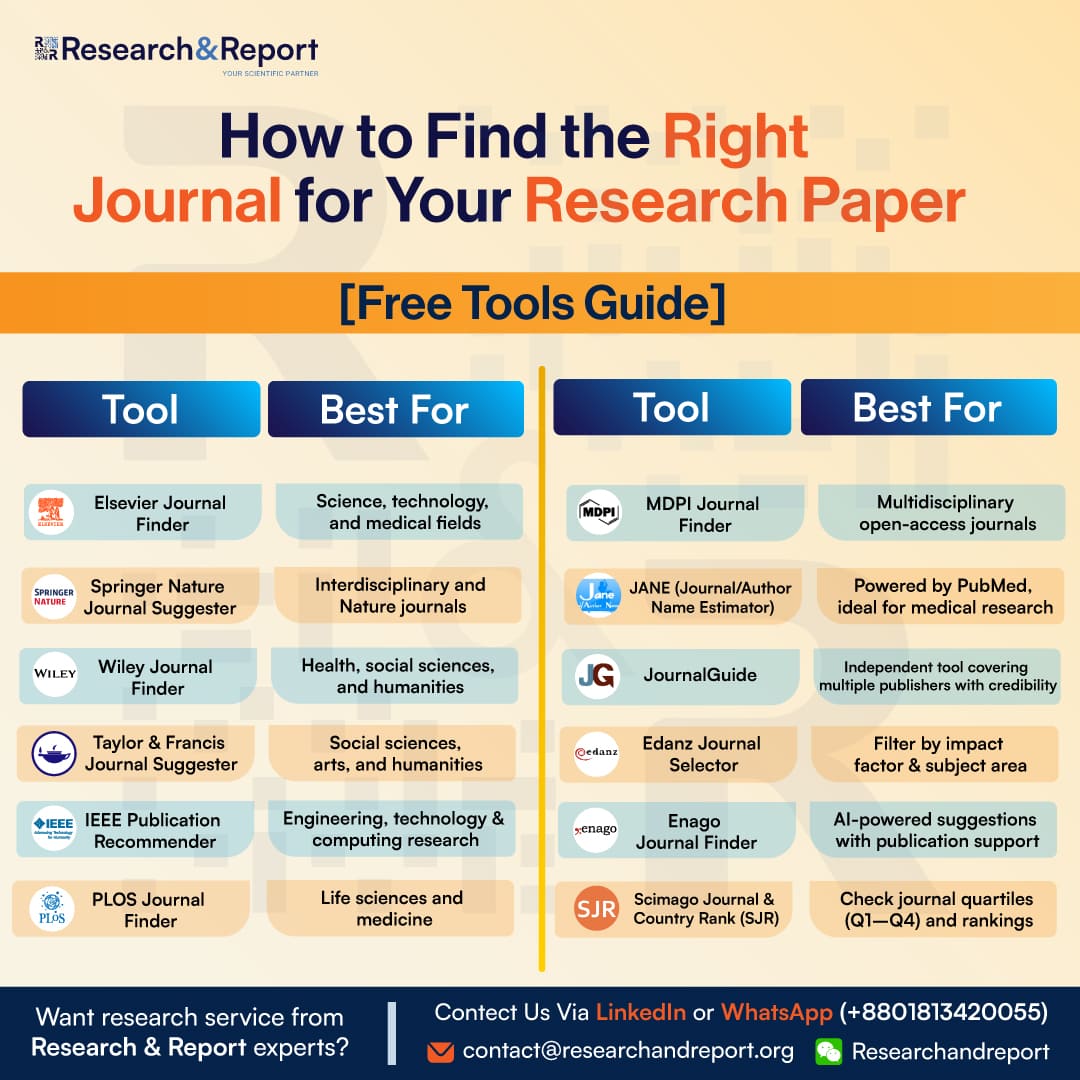
Elsevier Journal Finder (journalfinder.elsevier.com) matches your title and abstract against more than 2,600 Elsevier journals. It uses semantic similarity, not just keyword matching.
Best for: science, technology, and medical fields.
Springer Nature Journal Suggester (journalsuggester.springernature.com) covers interdisciplinary research and Nature-branded journals. It is particularly strong for life sciences and cross-disciplinary work.
Wiley Journal Finder (wiley.com/publish/journal-finder) targets health, social sciences, and humanities. Wiley publishes over 1,700 journals, so the tool provides meaningful disambiguation across a large catalog.
Taylor & Francis Journal Suggester (authorservices.taylorandfrancis.com) is best for social sciences, arts, and humanities researchers. Taylor & Francis publishes around 2,900 journals, many of which are highly specific to sub-disciplines.
IEEE Publication Recommender (ieeeauthorcenter.ieee.org) is the standard starting point for engineering, computer science, and technology research. IEEE’s portfolio spans over 200 transactions, journals, and magazines.
Critical note: Publisher tools show you their own catalog only. They have a commercial incentive to keep you within their ecosystem. Always cross-check suggestions against an independent tool.
Open Access Journal Finder Tools
Open access publishing removes paywalls for readers — but not always for authors. Article Processing Charges (APCs) can reach $3,000–$11,000 at some journals. These tools help you navigate legitimate OA options.
PLOS Journal Finder (plos.org/our-journals) covers PLOS’s family of peer-reviewed, fully open-access journals. PLOS ONE alone publishes across all scientific disciplines and has an acceptance rate of approximately 50%, making it a credible option for solid but broad-scope science.
MDPI Journal Finder (mdpi.com/about/journals) provides fast suggestions across MDPI’s large, multidisciplinary portfolio. MDPI journals are indexed in PubMed, Scopus, and Web of Science — but researchers should verify individual journal indexing, as not every MDPI title holds the same standing.
AI-Powered and Independent Journal Finder Tools
These are the most underused tools in academic publishing — and often the most powerful.
JANE — Journal/Author Name Estimator (jane.biosemantics.org) is powered by PubMed and is uniquely effective for biomedical and clinical research. Paste your abstract and JANE returns ranked journal matches with confidence scores and similar articles. It works backward from published research, not publisher catalogs.
JournalGuide (journalguide.com) is an independent, publisher-neutral tool covering journals from multiple publishers. It includes basic credibility filtering — a critical feature given the rise of predatory journals.
Edanz Journal Selector (edanz.com/journal-selector) allows researchers to filter results by impact factor range and subject area. This is especially useful when institutional requirements specify minimum impact factor thresholds.
Enago Journal Finder (enago.com/researcher-hub-journal-finder.htm) uses AI to match your manuscript profile to journals and also offers manuscript preparation support. The AI layer gives it an edge for researchers working across multiple disciplines simultaneously.
Credibility and Ranking Verification Tools
This is the step most researchers skip — and it is the most consequential.
Scimago Journal & Country Rank (SJR) (scimagojr.com/journalrank.php) is the gold standard for journal ranking verification. It classifies journals into quartiles from Q1 (top 25%) to Q4 (bottom 25%) within each subject category. Many universities and funding bodies require publication in Q1 or Q2 journals for promotion and grant eligibility.
DOAJ — Directory of Open Access Journals (doaj.org) is a community-curated whitelist of legitimate open-access journals. If an OA journal does not appear in DOAJ, treat that as a red flag and investigate further before submitting.
Critical warning: Predatory journals actively mimic legitimate ones — similar names, fake impact factors, and fabricated editorial boards. Cross-checking every open-access journal against DOAJ and Beall’s List is non-negotiable.
The 3 Things Most Researchers Don’t Know
1. Quartile matters more than impact factor alone. A journal’s impact factor (IF) is a single number that can be gamed or misrepresented. The SJR quartile is a better signal of real prestige because it accounts for the quality and influence of the citing journals, not just citation volume.
2. Abstract quality directly determines tool accuracy. Every AI-powered journal finder — JANE, Enago, Edanz — uses your abstract as its primary input. A vague, jargon-free abstract returns vague suggestions. A precise, well-structured abstract with clear methodology and outcome statements dramatically improves matching accuracy.
3. Submission timing affects acceptance probability. Many journals operate on annual cycles. Submitting just before or during a special issue can improve visibility and review speed. Tools like JournalGuide sometimes flag upcoming special issues — check for this before submitting.
Recommended Workflow for Researchers
Use this three-step process before formatting a single reference:
- Start with JANE or Enago — paste your abstract and generate an initial shortlist of 5–10 journals.
- Verify each suggestion on Scimago — confirm quartile ranking and subject category fit. Cross-check OA journals on DOAJ.
- Use the publisher’s own tool last — once scope and credibility are confirmed, the publisher tool helps with formatting requirements and turnaround time estimates.
Over to you: Which of these 12 tools have you actually used — and did it change your submission strategy? Drop your experience in the comments. If you’ve been burned by a predatory journal, sharing that story could save another researcher months of wasted work.
References
- Publons / Web of Science Group. (2023). Global State of Peer Review Report. https://clarivate.com/webofsciencegroup/peer-review/
- Scimago Journal & Country Rank. (2024). Journal Rankings by Subject. https://www.scimagojr.com/journalrank.php
- Directory of Open Access Journals (DOAJ). (2024). https://doaj.org
- JANE — Journal/Author Name Estimator. Biosemantics Group, Leiden University. https://jane.biosemantics.org
- Elsevier Journal Finder. (2024). https://journalfinder.elsevier.com
- Springer Nature Journal Suggester. (2024). https://journalsuggester.springernature.com
- Think. Check. Submit. (Predatory journal awareness initiative). https://thinkchecksubmit.org
- Beall’s List of Predatory Journals and Publishers. https://beallslist.net
Want research service from Research & Report experts? Please get in touch with us.