
Every researcher faces this decision. You have a strong manuscript. Do you target a Scopus Q1 journal and wait two years — or submit to Q2 and publish in nine months? The answer depends entirely on your goals, timeline, and career stage. This guide breaks down every factor so you can decide with clarity.
What Are Scopus Journal Quartiles?
Scopus divides indexed journals into four quartiles (Q1–Q4) based on their CiteScore ranking within a subject category. According to Elsevier’s Scopus source list, Q1 journals fall in the top 25% of their field. Q2 journals rank in the top 26–50%. Both quartiles are globally recognized, peer-reviewed, and accepted for academic credentials. The quartile system updates annually. A journal’s ranking can shift between cycles, making it important to verify current rankings before submitting.
Scopus Q1 Journals — The Gold Standard
Review Time and Rejection Rates
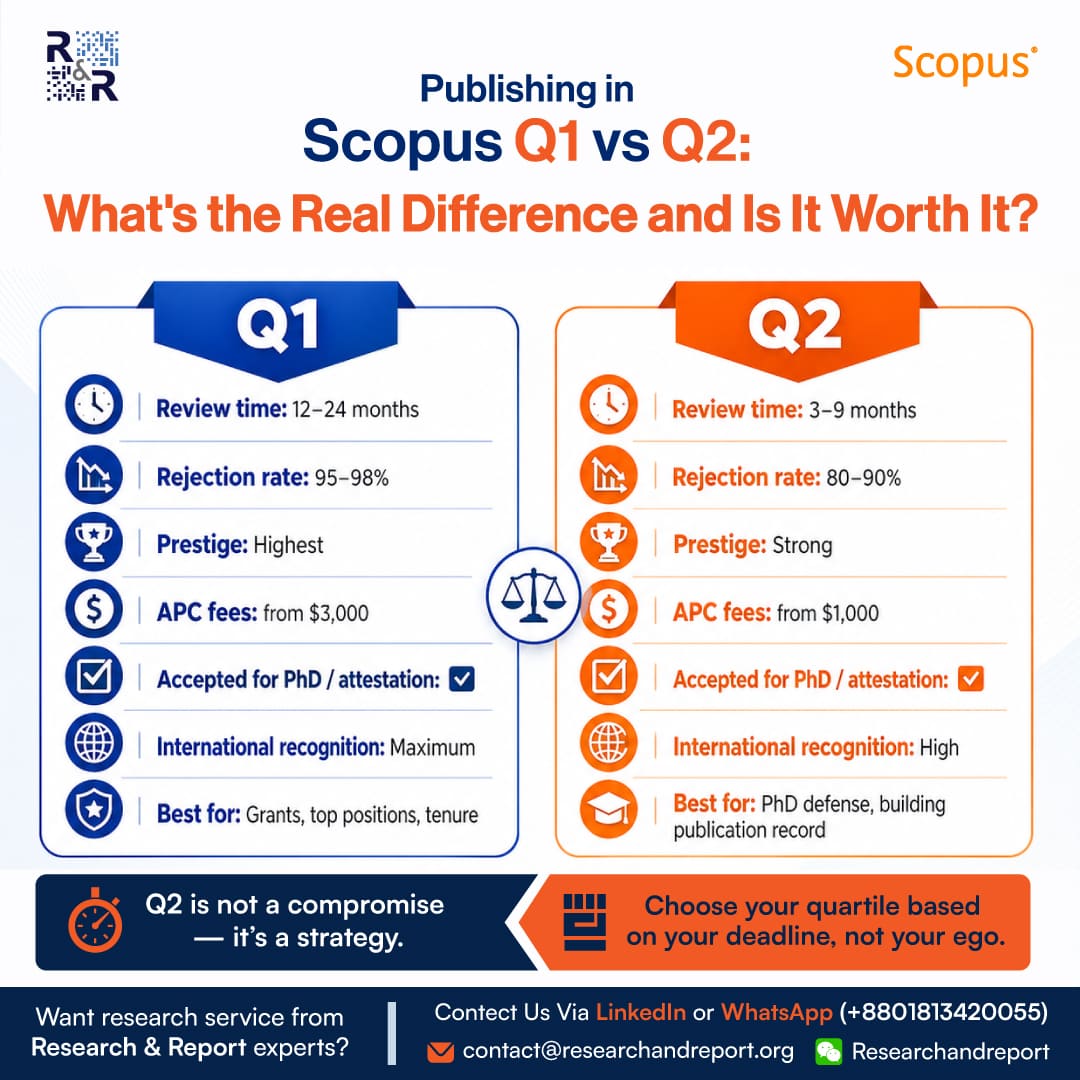
Q1 journals are the most selective publications in any field. Their peer review process typically takes 12–24 months. Rejection rates range from 95–98%. That means fewer than 5 manuscripts in every 100 submitted receive acceptance. This selectivity signals the highest editorial standards globally.
APC Fees and Prestige
Article Processing Charges (APCs) for Q1 journals start at approximately $3,000 and can exceed $9,500 for high-impact titles. Nature and Cell, for example, charge between $6,000–$11,000 per article (Nature Portfolio, 2024). However, many institutions and funders cover these fees through open-access agreements. The prestige payoff is maximum international recognition — your work reaches the broadest global readership.
Who Should Target Q1?
- Researchers pursuing tenure or full professorship
- Scientists applying for competitive national or international grants
- Academics building a long-term citation portfolio
- Established researchers with institutional APC support
Scopus Q2 Journals — The Strategic Choice
Faster Turnaround, Still Credible
Q2 journals deliver peer review decisions in 3–9 months. Rejection rates range from 80–90%. While still highly selective, Q2 journals offer a realistic publication pathway for early-career researchers. Their international recognition is classified as “high” — not “maximum,” but meaningfully significant for most academic purposes.
PhD and Attestation Acceptance
Both Q1 and Q2 journals satisfy PhD defense requirements and academic attestation processes in most countries. Regulatory bodies in the EU, Central Asia, and Southeast Asia formally accept Q2 publications as evidence of scholarly output. This makes Q2 a fully valid — not inferior — publication target for doctoral candidates.
Who Should Target Q2?
- PhD candidates with upcoming defense deadlines
- Early-career researchers building an initial publication record
- Researchers with limited institutional APC budgets
- Scientists working in fast-moving fields where speed matters more than prestige
The Hidden Costs of Chasing Q1
Time is a resource. A manuscript sitting in Q1 review for 18 months costs you opportunities. Grant cycles close. Defense deadlines pass. Faculty positions fill. Research that is published and citable outperforms unpublished “perfect” research every time. A 2022 study in Scientometrics found that publication delay significantly reduces a paper’s early citation impact, particularly in fast-moving STEM disciplines. Chasing Q1 when your timeline demands Q2 is not ambition — it is a strategic misalignment.
When Q2 Is the Smarter Move
Q2 is not a compromise. It is a calibrated strategy. Consider this: a Q2 paper published and cited while you are still active in your field compounds your academic capital. A Q1 paper published after a two-year wait, when a conference presentation or thesis chapter would have served better, does not. Choose based on your deadline, not your ego.
Decision rule: If your career milestone is within 12 months, Q2 is your optimal target. If you have 24+ months and institutional support, Q1 deserves serious consideration.
How Scopus Quartiles Affect Your Academic Career
Key Decision Factors by Career Stage
- PhD student (Year 3–4): Q2 — fast review, accepted for defense, builds your CV before graduation
- Postdoctoral researcher: Mix — Q2 for rapid output, Q1 for one flagship publication per year
- Junior faculty (pre-tenure): Q1 focus — tenure committees weigh Q1 heavily in most institutions
- Senior researcher: Q1 — grant applications and international collaboration invitations favor Q1 records
- Independent / industry researcher: Q2 — faster dissemination, lower cost, still globally recognized
References
- Elsevier. (2024). Scopus Source List and CiteScore Metrics. https://www.scopus.com/sources
- Nature Portfolio. (2024). Article Processing Charges. https://www.nature.com/nature-portfolio/open-access/fees
- Heneberg, P. (2022). Publication delays and early citation impact in STEM disciplines. Scientometrics. https://doi.org/10.1007/s11192-022-04259-5
- Elsevier. (2024). Understanding CiteScore and Scopus journal ranking methodology. https://service.elsevier.com/app/answers/detail/a_id/14884
- Web of Science Group. (2023). Journal Citation Reports: Impact Factor methodology. https://clarivate.com/academia-government/solutions/web-of-science
💬 Question to drive comments and dwell time:
Are you currently deciding between Q1 and Q2 for your next manuscript? What’s the biggest factor holding you back — prestige, timeline, or APC cost? Drop your field and career stage below — let’s help each other choose smarter.
Need research service from Research & Report experts? Please get in touch with us.