
Many researchers believe that a literature review is simply a summary of past work. But this mindset leads to shallow output and missed opportunities. At Research & Report Consulting, we help clients transform their literature reviews into strategic foundations for originality and impact. Below we will walk you through the critical issues many researchers miss, explain advanced techniques including thematic synthesis, critical mapping and evidence grading, and show how you can elevate your review today.
Common Mistakes Most Researchers Make
- They compile individual study summaries rather than synthesising across studies.
- They neglect contradictions, debates or conceptual gaps in the literature.
- They follow a chronological or author-by-author structure rather than a thematic or analytical one. CwAuthors
- They fail to grade the strength of evidence or map how studies relate to one another.
These mistakes reduce your literature review to a descriptive exercise instead of a strong analytical platform. The goal should be to make your literature review a conversation, not a catalogue.
Why a Critical Literature Review Matters
A literature review that is just descriptive:
- reveals what is known but not what is not known.
- fails to position your research for originality.
- misses the opportunity for meaningful debate and conceptual insight.
By contrast, a critical review:
- highlights contradictions, unresolved debates, and gaps.
- synthesises across studies to establish patterns and themes.
- uses evidence-grading or mapping tools to show where your research will make impact.
- positions your work as the next logical step, rather than “here’s what’s out there”.
Step-by-Step Techniques You Can Use
1. Define your scope and research question
Before diving into sources, clearly define your research question or objective. Use that as a compass for what to include and how to evaluate. Brown University Library Guides
2. Use thematic synthesis
Instead of summarising each study, use a thematic approach:
- Identify recurring themes across the literature. ATLAS.ti
- Organise your review around themes (typically 3-5 major ones). Degree Doctor®
- Use three stages: line-by‐line coding, descriptive themes, and analytical themes. BioMed Central
3. Critical mapping of the literature
Construct visual maps or matrices showing how studies relate:
- Which studies agree? Which contradict each other?
- Where are theoretical or methodological gaps?
- Use a synthesis matrix to capture authors, themes, gaps, and commentary. Brown University Library Guides
4. Evidence grading
Assess how strong and reliable each sub-area is:
- Use frameworks such as the GRADE approach (Grading of Recommendations Assessment, Development and Evaluation) to rate evidence strength. Wikipedia
- Ask: Are findings robust? Are methodologies sound? What is the risk of bias? Wikipedia
- This makes your review more than a narrative — it becomes critical appraisal.
5. Identify gaps and position your research
- Use findings to pinpoint what has not been done.
- Link gap analysis to your research aim: “Because of X contradiction, my study will explore Y.”
- A gap without justification leads to weak research positioning.
6. Write with coherence and flow
- Use active voice and transitions to guide the reader.
- Keep sentences short (<20 words).
- Use sub-heads and bullets for scan-ability.
- Always circle back to how your work links to the themes and gaps you identified.
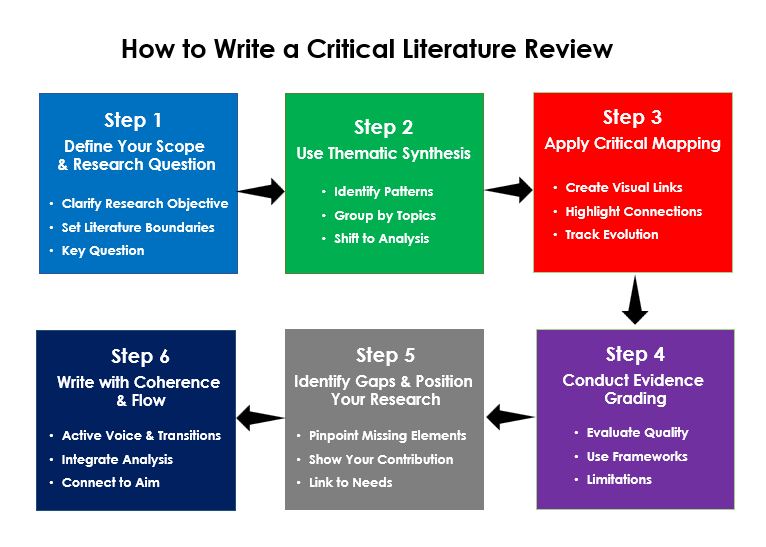
Figure: Steps of writing critical literature review
Conclusion
When you stop summarising and start synthesising, mapping and grading, your literature review changes from a background section to a strategic tool for originality and impact.
➡️ We turn your literature review into a foundation for originality and impact.
Ready to elevate your review? Contact us today.
Question for you: What’s the single biggest challenge you face in writing your literature review? Leave a comment below — we’d love to help.
References
- ATLAS.ti. “Thematic Analysis Literature Review | Structure & Examples.” 2024. ATLAS.ti
- CW Authors. “How to structure and write a Thematic Literature Review.” 2023. CwAuthors
- BMC Medical Research Methodology. “Methods for the thematic synthesis of qualitative research in systematic reviews.” 2008. BioMed Central
- DissertationByDesign. “Four Ways to Structure Your Literature Review.” 2023. dissertationbydesign.com
- Brown University LibGuides. “Organizing and Creating Information: Literature Reviews.” 2024. Brown University Library Guides
- Wikipedia. “Critical appraisal.” 2025. Wikipedia
- Wikipedia. “Hierarchy of evidence.” 2025. Wikipedia