
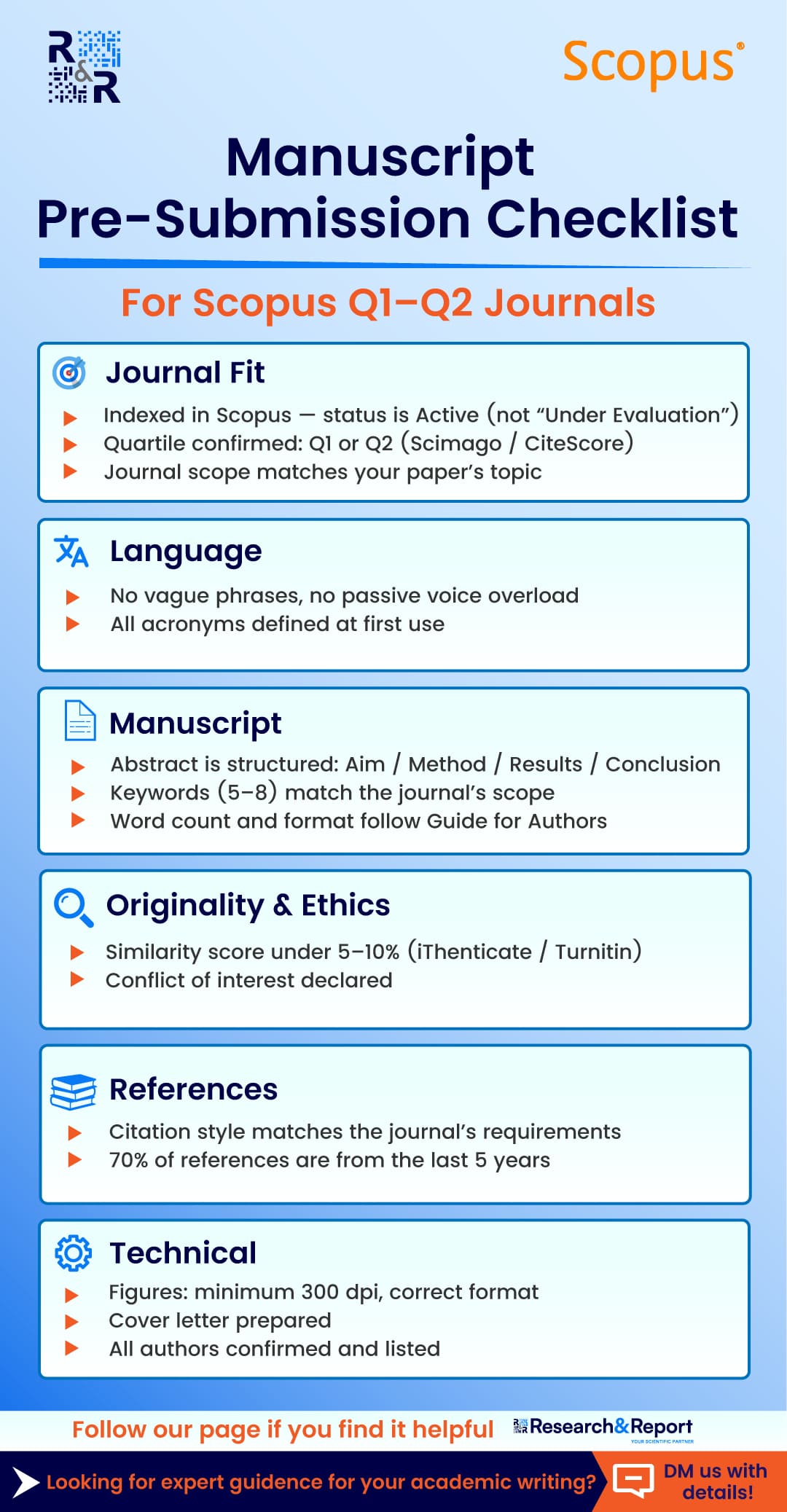
Publishing in Scopus-indexed Q1–Q2 journals is a benchmark of academic excellence. However, a significant number of manuscripts are rejected before peer review, not due to poor research quality, but because of avoidable submission errors.
This comprehensive guide provides a step-by-step pre-submission checklist to help researchers maximize acceptance rates and ensure compliance with top-tier journal standards.
Why a Pre-Submission Checklist Matters
High-impact journals follow strict editorial screening processes. Editors evaluate:
- Relevance to journal scope
- Language quality
- Ethical compliance
- Formatting and structure
Failure in any of these areas can result in desk rejection within days.
A structured checklist ensures:
- Reduced rejection risk
- Faster review timelines
- Stronger first impression
1. Journal Fit: The Foundation of Acceptance
Selecting the right journal is critical.
Key Checks:
- Confirm the journal is indexed in Scopus (Active status)
- Verify quartile ranking (Q1 or Q2) via Scimago or CiteScore
- Ensure the journal scope aligns with your research topic
Pro Tip:
Avoid journals listed as “Under Evaluation”—these may not guarantee indexing continuity.
| Criteria | What to Check | Why It Matters |
|---|---|---|
| Indexing Status | Active in Scopus | Ensures recognition |
| Quartile Ranking | Q1 or Q2 | Indicates impact level |
| Scope Alignment | Matches your topic | Improves acceptance probability |
| Publisher Credibility | Reputable publishers | Avoids predatory journals |
2. Language Quality: Clarity Drives Impact
Even strong research can fail due to poor writing.
Checklist:
- Avoid vague or ambiguous phrases
- Minimize excessive passive voice
- Maintain consistency in tense and tone
- Define all acronyms at first use
Example:
❌ Weak: “It was found that results were significant.”
✅ Strong: “The results show statistically significant improvement.”
3. Manuscript Structure: Follow the Standard Format
Top journals expect a clear and logical structure.
Essential Components:
- Abstract: Structured (Aim – Method – Results – Conclusion)
- Keywords: 5–8 relevant terms aligned with indexing databases
- Main Sections:
- Introduction
- Literature Review
- Methodology
- Results
- Discussion
- Conclusion
Tip:
Strictly follow the “Guide for Authors” of your target journal.
4. Originality & Ethics: Non-Negotiable Requirements
Ethical compliance is critical in scholarly publishing.
Key Requirements:
- Similarity index should be below 5–10%
- Use plagiarism detection tools like:
- Turnitin
- iThenticate
- Declare:
- Conflict of interest
- Funding sources
- Ethical approvals (if applicable)
Warning:
High similarity or undeclared conflicts can lead to immediate rejection or blacklisting.
5. References: Strengthen Your Credibility
References reflect the depth and relevance of your research.
Checklist:
- Use the journal’s required citation style (APA, Harvard, IEEE, etc.)
- Ensure at least 70% of references are from the last 5 years
- Include recent Q1–Q2 journal articles
Tip:
Use reference managers like:
- Zotero
- Mendeley
- EndNote
6. Technical Requirements: Often Overlooked
Many submissions fail due to simple technical errors.
Must-Check Items:
- Figures resolution: Minimum 300 dpi
- Correct file formats (JPEG, TIFF, EPS)
- Tables properly formatted
- Supplementary materials included (if required)
- Cover letter prepared
- All authors listed and approved
| Section | Status (✔/✘) |
|---|---|
| Journal Fit Verified | |
| Language Reviewed | |
| Abstract Structured | |
| Keywords Optimized | |
| Plagiarism Checked | |
| References Updated | |
| Figures High Quality | |
| Cover Letter Ready |
Common Mistakes to Avoid
- Submitting to mismatched journals
- Ignoring author guidelines
- Using outdated references
- Poor grammar and unclear writing
- Missing ethical declarations
Final Thoughts
Publishing in Scopus Q1–Q2 journals is competitive—but not impossible. A well-prepared manuscript that meets all editorial, ethical, and technical standards significantly increases your chances of success.
A pre-submission checklist is not just a formality—it is a strategic tool for publication success.
References
- Elsevier. (2024). Guide for Authors.
- Scopus Sources List.
https://www.scopus.com/sources - SCImago Journal Rank (SJR).
https://www.scimagojr.com - COPE (Committee on Publication Ethics).
https://publicationethics.org - Turnitin Plagiarism Checker.
https://www.turnitin.com - Elsevier Researcher Academy.
https://researcheracademy.elsevier.com
Looking for expert guidance for your academic writing? Contact us.