
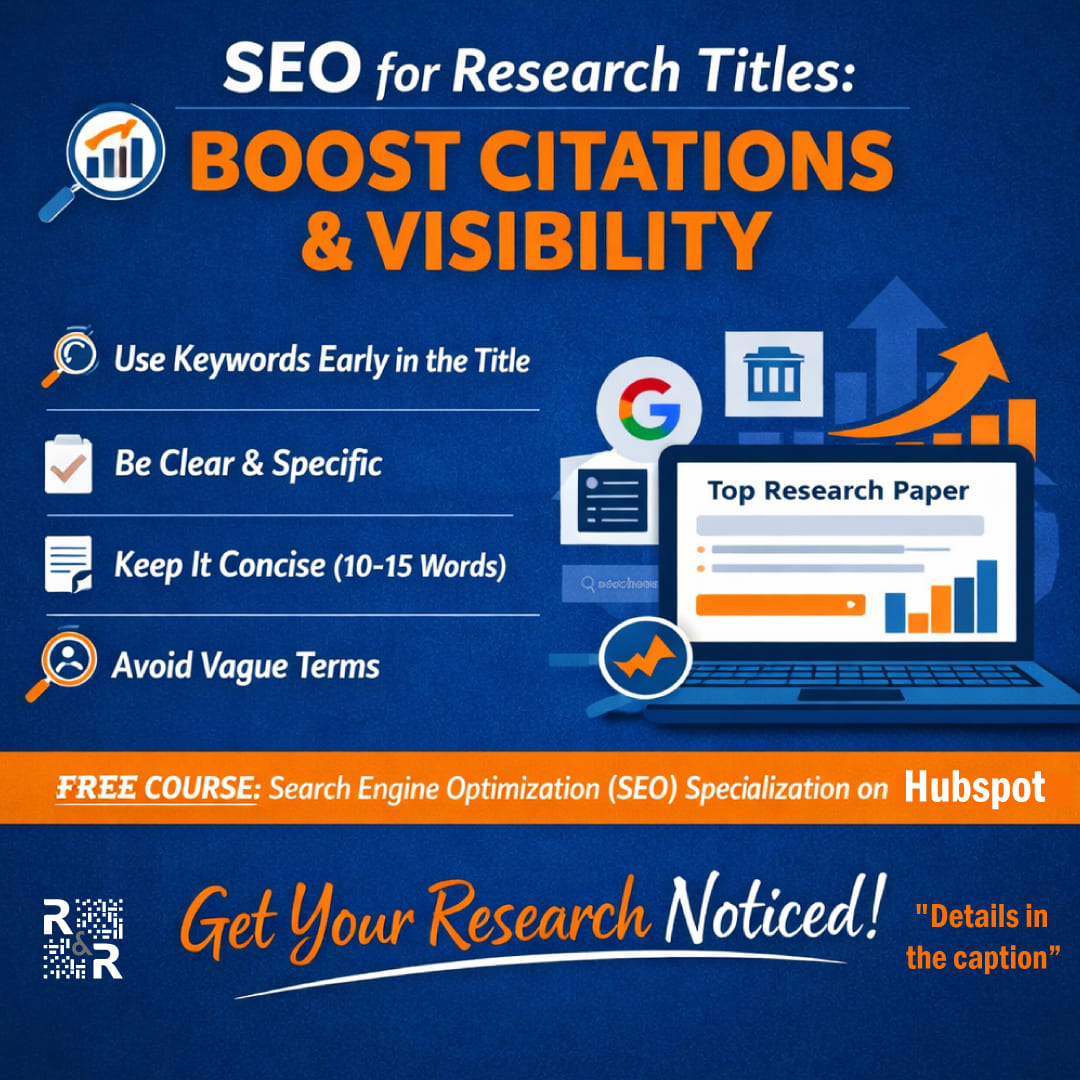
Academic publishing has changed dramatically in the digital era. Researchers now discover papers primarily through search engines and academic databases.
Platforms such as Google Scholar, Scopus, and institutional repositories depend heavily on keyword matching. This shift created a new concept called Academic SEO (ASEO).
ASEO applies search optimization strategies to scholarly content. The goal is simple: make research papers easier to find online.
According to Wiley, around 58% of journal traffic comes from Google and Google Scholar. Another study by Taylor & Francis found a strong link between online visibility and citation rates.
Simply put:
If readers cannot find your paper, they cannot cite it. That is why optimizing research titles is becoming essential.
Why Research Titles Matter for SEO
The research title is the first searchable element of your article. Search engines analyze titles to determine relevance. Most indexing systems give high ranking weight to title keywords. This means a poorly written title can reduce discoverability.
Well-optimized titles offer several advantages:
• Improve visibility in search results
• Increase click-through rates
• Boost downloads and readership
• Increase citation potential
Publishers such as Elsevier recommend placing important keywords early in the title for maximum discoverability.
Evidence Linking SEO Titles to Research Visibility
Several studies confirm the impact of optimized titles. Research by Pottier et al. (2024) analyzed thousands of journal articles. The study found that keyword placement strongly influences search ranking. Papers with optimized titles were more likely to appear in search results.
Another study by Chawla (2025) examined citation patterns. It showed that clear and descriptive titles receive more citations.
Search engines also prioritize text matching. Therefore, including the correct keywords increases the chances of appearing in relevant searches.
Best Practices for SEO-Optimized Research Titles
1. Place Keywords at the Beginning
Search engines prioritize early keywords.
Example:
❌ A Novel Approach to Climate Monitoring
✅ Satellite Remote Sensing for Climate Monitoring
Early keywords improve ranking and search relevance.
2. Keep Titles Concise
- Short titles improve readability.
- Concise titles also prevent truncation in search results.
- Many journals recommend 10–15 words.
- Avoid unnecessary filler words.
- Concise titles also prevent truncation in search results.
3. Use Field-Specific Terminology
Choose words researchers actually search for. Tools that help identify keywords include:
• Google Scholar autocomplete
• Google Trends
• PubMed
Avoid obscure jargon or internal terminology.
4. Be Specific and Descriptive
- Titles should clearly explain the study.
- Readers must understand the topic instantly.
- Avoid vague or creative titles.
- Search engines prefer descriptive wording.
5. Ensure Title Uniqueness
Duplicate titles can confuse indexing systems.
Before finalizing your title:
• Search it in Google Scholar
• Check similar articles
• Adjust wording if necessary
Unique titles rank better.
SEO Framework for Writing Research Titles
Follow this five-step framework.
Step 1: Keyword Research
- Identify 2–3 primary keywords.
- Search them in academic databases.
Step 2: Draft the Title
- Include the keywords naturally.
- Place them early in the sentence.
Step 3: Optimize Length
- Keep the title concise.
- Aim for clarity and readability.
Step 4: Search Test
- Search the title online.
- Check whether similar titles exist.
Step 5: Align with Journal Guidelines
- Follow formatting rules.
- Some journals limit title length.
Future Role of Academic SEO
- Academic SEO will become increasingly important.
- Research visibility now depends on digital discoverability.
- Libraries, publishers, and universities encourage authors to learn SEO.
- Even small changes in title wording can improve research impact.
In the future, scholars may use AI-assisted SEO tools to optimize research papers.
Conclusion
Research titles are more than labels. They are strategic discovery tools. Optimizing titles with relevant keywords increases visibility. Higher visibility leads to more readership and citations.
Researchers who understand SEO gain a competitive advantage in academic publishing.
References
- Wiley Author Services
- Taylor & Francis Author Guidelines
- Elsevier Researcher Academy
- Pottier, J. et al. (2024). Academic SEO and Discoverability.
- Google Scholar Help
Do you think SEO should become a standard skill for researchers and PhD students?
Share your opinion in the comments.
Looking for assistance for your research? Contact us.