
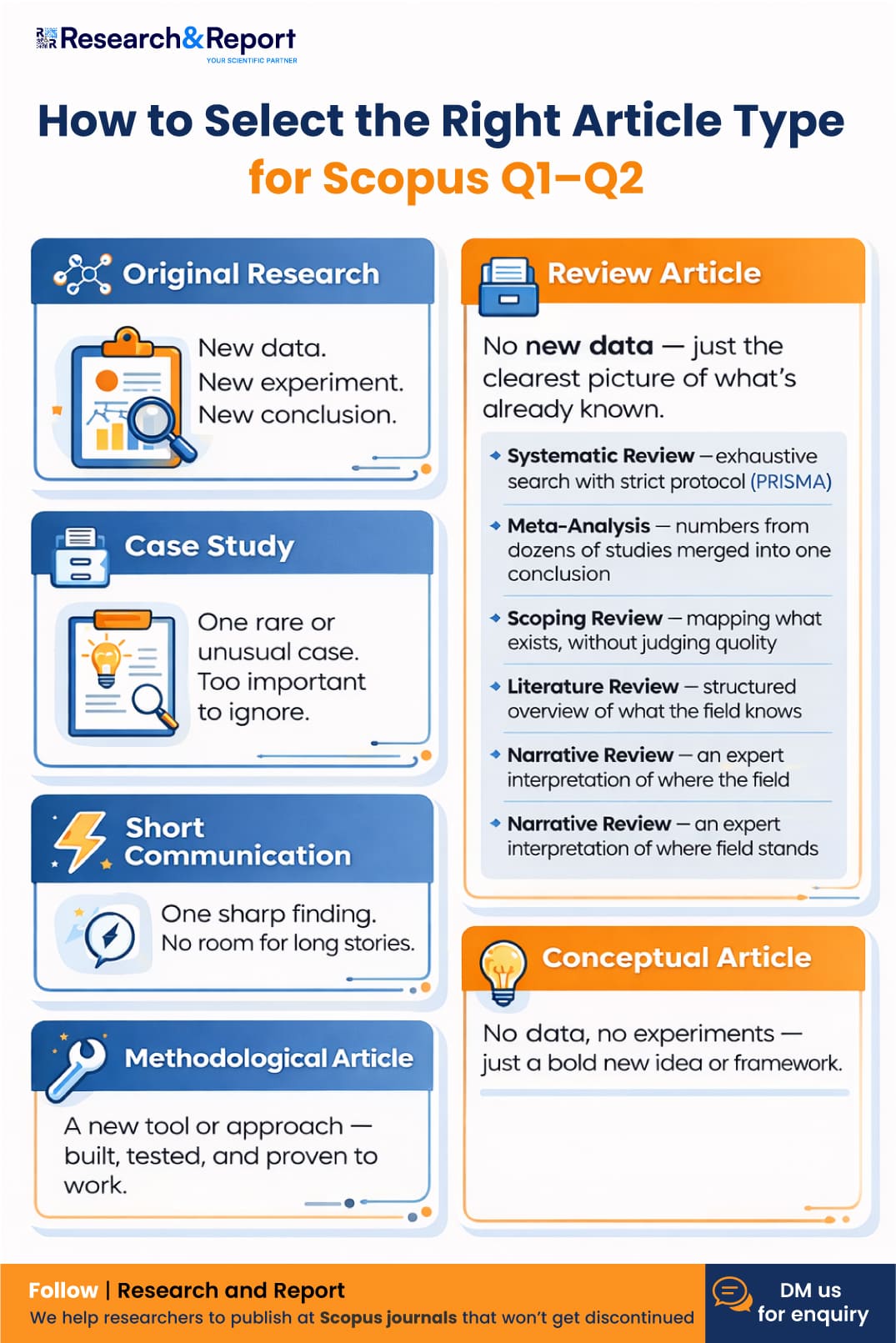
Publishing in Scopus Q1–Q2 journals is highly competitive. Many researchers assume rejection is due to weak research. In reality, a common reason is choosing the wrong article type.
This is not a quality issue—it’s a strategic mismatch.
In this guide, you’ll learn how to select the right article type to improve your chances of acceptance.
Why Article Type Selection Matters
Most journals follow strict editorial screening before peer review. If your manuscript doesn’t match the required format, it gets rejected instantly.
Common Mistakes
- Submitting a Narrative Review where only Systematic Reviews (PRISMA) are accepted
- Sending a Case Study to journals that don’t publish case reports
- Writing Original Research without a clear novelty statement
👉 Result: Desk rejection within days
Types of Articles in Scopus Q1–Q2 Journals
1. Original Research Article
Best for:
- New data
- Experiments
- Novel findings
Key Requirements:
- Clear research gap
- Strong methodology
- Defined novelty statement
📌 Example:
A study introducing a new AI-based diagnostic model with tested results.
2. Review Articles
These summarize existing research instead of presenting new data.
Types of Review Articles
| Type | Description | Acceptance in Q1 |
|---|---|---|
| Systematic Review | Structured, PRISMA-based | High |
| Meta-Analysis | Statistical data combination | Very High |
| Scoping Review | Research mapping | Moderate |
| Literature Review | General overview | Moderate |
| Narrative Review | Expert opinion | Low |
3. Case Study
Best for:
- Rare or unique cases
- Field-specific insights
⚠️ Important: Many Q1 journals do NOT accept case studies.
4. Short Communication
Used when:
- You have one strong finding
- Results need fast publication
Features:
- Short length
- Limited data
- Quick review process
5. Conceptual Article
Best for:
- New theories
- Models or frameworks
No experimental data required
📌 Example: A new framework for digital marketing strategy in emerging markets.
6. Methodological Article
Focuses on:
- New tools
- Research techniques
- Improved methods
📌 Example: A new statistical model for big data analysis.
Quick Comparison Chart
| Article Type | Data Required | Acceptance Rate | Best For |
|---|---|---|---|
| Original Research | Yes | High | New findings |
| Systematic Review | No (secondary data) | Very High | Evidence synthesis |
| Meta-Analysis | Yes (existing datasets) | Very High | Statistical validation |
| Case Study | Limited | Low | Unique cases |
| Short Communication | Minimal | Moderate | Fast results |
| Conceptual | No | Moderate | Theories |
| Methodological | Yes | High | Tools & techniques |
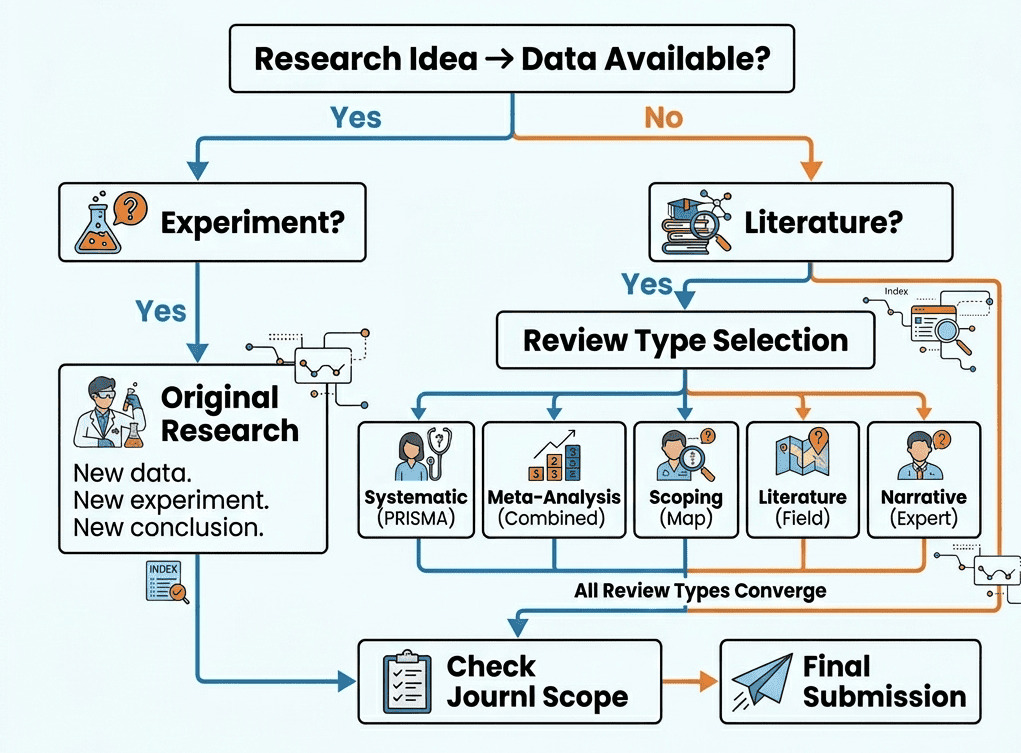
How to Choose the Right Article Type (Step-by-Step)
1: Define Your Research Goal
- New experiment → Original Research
- Summary of studies → Review Article
2: Check Journal Guidelines
- Accepted article types
- Formatting requirements
- Methodology standards
3: Match Your Data
- No data? → Conceptual or Review
- Strong dataset? → Original or Meta-analysis
4: Evaluate Acceptance Trends
- Q1 journals prefer:
- Systematic Reviews
- Meta-Analyses
- High-quality Original Research
Real-Life Example
❌ A researcher submits a Narrative Review to a journal requiring PRISMA → Rejected
✅ Same topic rewritten as a Systematic Review → Accepted
👉 Lesson: Format matters as much as content.
Pro Tips for Scopus Publication Success
- Always read “Guide for Authors”
- Use PRISMA guidelines for systematic reviews
- Highlight novelty in abstract and introduction
- Avoid sending the same format to all journals
Conclusion
Choosing the right article type is not optional—it’s half of your publishing success.
A strong paper in the wrong format will fail.
A well-structured paper in the right format can succeed—even in Q1 journals.
References
- PRISMA Guidelines
https://www.prisma-statement.org/ - Elsevier Author Guidelines
- Springer Journal Author Instructions
https://www.springer.com/gp/authors-editors/journal-author - Wiley Journal Guidelines
https://authorservices.wiley.com/ - Scopus Sources List
https://www.scopus.com/sources
Looking for research service from experts? Contact us.