
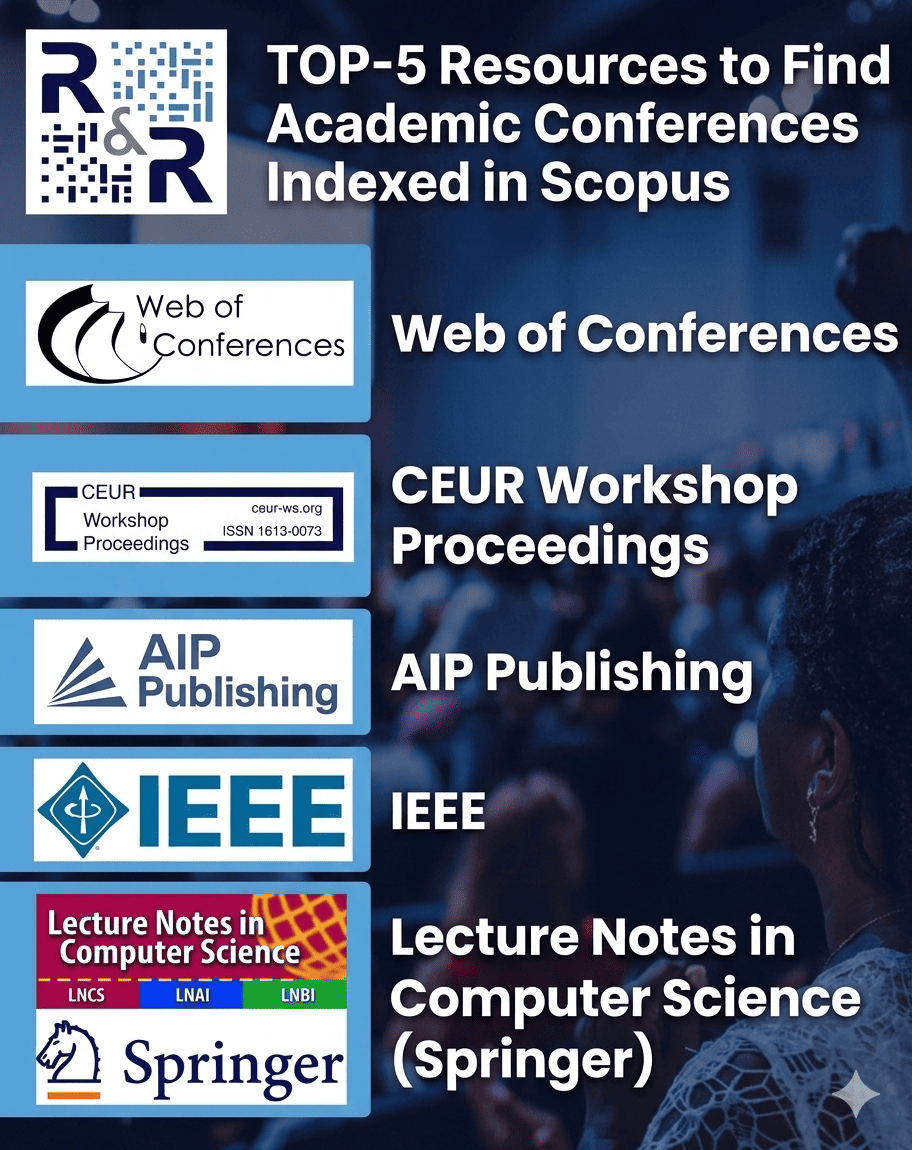
Publishing at a Scopus-indexed conference can boost your research visibility and citations. Scopus now covers over 148,000 conferences and 11.7 million papers, roughly 12% of its database. However, not all “indexed” claims are equal. The best approach is to target reputable proceedings series and always verify indexing via the official Scopus Sources list.
Major Scopus-Indexed Conference Proceedings
- IEEE Conference Proceedings (IEEE Xplore): Globally recognized in engineering and technology. IEEE publishes thousands of conferences each year, and most (≈90%+) of IEEE Xplore content is indexed in Scopus. Presenting at IEEE events offers excellent networking and credibility.
- Springer LNCS (Lecture Notes in Computer Science): A prestigious series for computer science. LNCS includes subseries (LNAI, LNBI) and publishes 600+ volumes (~20,000 papers) per year. Springer ensures rigorous peer review and Scopus indexing.
- ✅ Indexed: Proceedings are submitted to Scopus (and CPCI, EI, DBLP).
- ⚠️ Consider: Very selective acceptance. The top LNCS conferences often require conference registration (sometimes with fee) and strict review.
- AIP Conference Proceedings (American Institute of Physics): Strong in physics, materials science, and engineering. AIP publishes >100 volumes annually with ~100,000 papers.
- ✅ Indexed: Listed in Scopus and major indexing services. Authors retain copyright and can choose open access.
- ⚠️ Consider: Publication can be costly. (AIP’s “Author Select” open-access option is ~$3,800 USD; conference organizers typically cover costs.) Check if the series is still indexed and whether an APC applies.
- EDP Sciences – Web of Conferences (EPJ, E3S, BIO): These open-access series cover STEM fields (physics, environment, biology). For example, EPJ Web of Conferences (for physics) was indexed by Scopus in 2024, joining E3S and BIO Web of Conferences. EDP’s policy: no APC for authors; organizers pay the publishing fee.
- ✅ Indexed: EPJ, E3S, BIO Web of Conferences are recognized in Scopus.
- ⚠️ Consider: Focus is on natural sciences/engineering. Proceedings are fast-published but organizers bear costs. Confirm that the specific event is tracked by Scopus.
- CEUR Workshop Proceedings: A free, diamond Open Access service for computer science workshops (hosted by RWTH Aachen). CEUR is widely used in CS/IT and provides rapid publication.
- ✅ Indexed: Many CEUR volumes are crawled by Scopus and Google Scholar, but CEUR has no formal agreement with indexers. Always verify each volume’s status in Scopus.
- ⚠️ Consider: No fee at all for authors or organizers. However, CEUR has lower prestige; not every volume may be indexed. Rely on the Scopus Source List to check coverage.
How to Verify Scopus Indexing
- Use the official Scopus Sources – Go to Scopus Sources (no subscription needed). Search by the proceedings series title or ISSN.
- Check Coverage Years – Ensure the series shows “to Present.” If coverage ends in past years, do not submit.
- Identify the Publisher/Series – Determine who publishes the proceedings (e.g. IEEE, Springer, AIP). Then search that series (e.g. “IEEE Conference Proceedings” or “Lecture Notes in Computer Science”) in Scopus.
- Ask for Proof – Legit organizers can provide the ISBN or a link to the most recent volume in Scopus. Beware claims of “automatic indexing.”
- Red Flags of Fake Conferences: Guaranteed acceptance, unrealistically fast review, personal email organizers, hidden fees. Always check if previous editions are indexed.
Choosing the Right Conference Venue
- Match your field: Publish with the series known in your discipline. E.g., use IEEE/ACM conferences in engineering, Springer’s LNCS for CS, AIP proceedings for physics, EDP WebConfs for general STEM, CEUR for CS workshops.
- Balance prestige vs. speed: Higher-prestige venues (e.g. top IEEE or LNCS conferences) often have strict review and require early submission. Lower-cost venues (CEUR, smaller workshops) publish faster but may have less impact.
- Consider costs: IEEE and AIP conferences often charge fees. Springer LNCS does not charge authors (organizers and participants usually cover conference fees). EDP WebConf has no author fee, but organizers pay. CEUR is free for all.
- Networking & impact: Conferences like IEEE or Springer-backed events often have large attendance and visibility. Open-access proceedings (EDP, CEUR) increase readership but may have narrower audiences.
Tip: Always run the conference series title or ISSN through Scopus’s Source List. Scopus is the definitive source to confirm if your chosen venue is truly indexed.
References
- OpenScience.eu – “Open Research Platforms – Part 2” (March 2023): Scopus database stats.
- Wikipedia – AIP Conference Proceedings: history, scope, indexing.
- EDP Sciences – EPJ Web of Conferences now indexed in Scopus (Oct 2024).
- EDP Sciences – Publication Charges for Conferences: No APC for authors.
- Springer Nature – Lecture Notes in Computer Science (series page): indexing and scale.
- IEEE Author Center – AI Scholar News: IEEE Xplore vs. Scopus (Feb 2026).
- AiScholar – How to Verify Scopus Indexing: Step-by-Step Guide (Jan 2026).
- CEUR Workshop Proceedings – How to Submit (RWTH Aachen): “free of charge for organizers and readers”.
Want research service from Research & Report experts? Please get in touch with us.