
Qualitative research depends on trustworthiness, not statistical generalization. When researchers omit key components of an audit trail, reviewers cannot see who decided what, when, and why. As a result, credibility, dependability, and confirmability weaken—even when the dataset is rich and quotes appear compelling.
A rigorous audit trail acts as the study’s backbone. It links raw data, analytic decisions, interpretation, and reporting. Without it, readers cannot verify logic, reviewers cannot assess consistency, and editors cannot judge methodological integrity.
Common Audit Trail Blind Spots (Most Teams Miss These)
These recurring gaps appear across dissertations, journal submissions, NGO evaluations, and consultancy reports:
1. No Decision Log for Sampling Shifts
Researchers often change sampling mid-study—yet fail to record:
- Why the shift happened
- Who approved it
- What criteria changed
- Whether stopping rules were applied
This omission breaks traceability and raises concerns about bias or convenience sampling.
2. Codebook Changes Without Changelog
Qualitative coding is iterative. Yet many teams:
- Modify category definitions
- Merge overlapping codes
- Rename parent/child nodes
- Reassign segments
These shifts need a changelog and adjudication record to prove analytic discipline.
3. Missing Reflexivity Documentation
Reflexivity links researcher stance to interpretation. Without it:
- Positionality influences remain invisible
- Interpretation risks appear uncontrolled
- Reviewer confidence drops
Reflexive documentation is a core COREQ and SRQR requirement.
4. Unclear Quote Provenance
Many manuscripts present quotations without:
- Source ID
- Demographic metadata
- Contextual notes
- Coding history
Without provenance, triangulation and auditability collapse.
5. Version Control Chaos
Untracked files, overwritten transcripts, and uncontrolled codebook iterations create analytic inconsistencies. This leads to:
- Unreproducible analysis
- Weak chain of evidence
- Reporting inconsistencies
Researchers must use structured version control systems.
Fast Fixes Editors and Reviewers Value
These interventions immediately strengthen transparency and traceability:
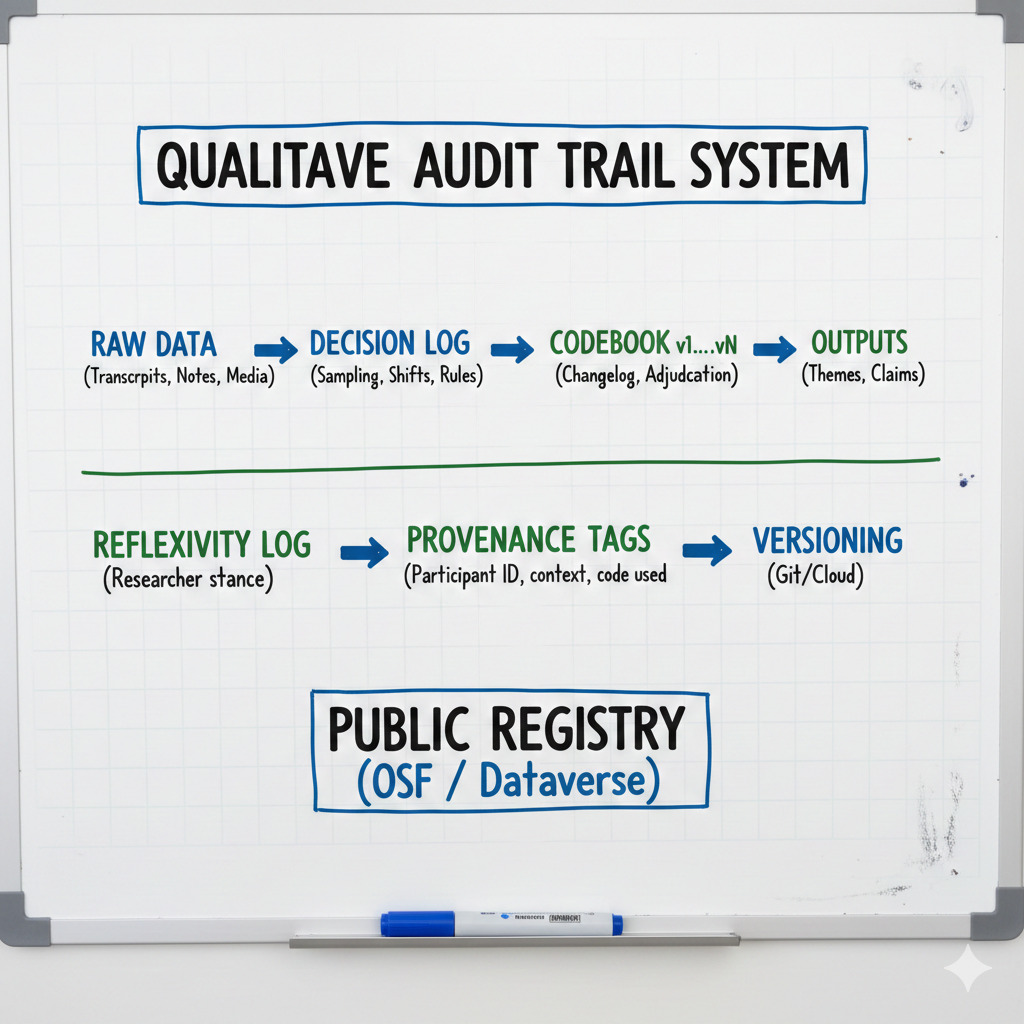
1. Start With a Living Decision Log
Begin on day one. Update continuously.
- Sampling decisions
- Inclusion/exclusion criteria
- Analytic shifts
- Researcher memos
A living log shows methodological discipline.
2. Maintain a Codebook Changelog with Adjudication Register
Every update should track:
- Code definition updates
- Node merges/splits
- Inter-coder disagreements
- Final adjudication decisions
Use Git, Notion, or Google Docs version control to keep everything traceable.
3. Add Provenance Tags to All Excerpts
Each quotation should record:
- Participant ID
- Data source
- Collection date
- Code version used
This yields a clear chain of evidence.
4. Register Materials in OSF or Dataverse
Transparency increases acceptance likelihood. Register:
- Codebooks
- De-identified excerpts
- Audit logs
- Reflexive journals
- Protocols
5. Report Against COREQ/SRQR
These frameworks are widely recognized by top journals. Reporting against them signals credibility and methodological rigor.
The Business Case for a Strong Audit Trail
Organizations increasingly rely on qualitative research for policy, product design, and impact evaluation. Poor audit trails increase:
- Reviewer rejection rates
- Audit risks in development projects
- Reproducibility challenges
- Legal exposure in regulated sectors
A strong audit trail protects credibility, institutional memory, and organizational reputation.
Service Mention (Neutral, Non-Promotional)
A structured audit-trail framework—templates, workflows, chain-of-evidence tables, and registries—helps teams produce traceable, review-ready qualitative studies.
References
- Lincoln, Y. S., & Guba, E. G. (1985). Naturalistic Inquiry.
- O’Brien, B. C., et al. (2014). “Standards for Reporting Qualitative Research (SRQR).”
- Tong, A., Sainsbury, P., & Craig, J. (2007). “Consolidated Criteria for Reporting Qualitative Research (COREQ).”
- OSF Registries (Open Science Framework).
Want research service from Research & Report experts? Please get in touch with us.